Showing posts with label Biopic. Show all posts

Saturday, July 31, 2010

Skin


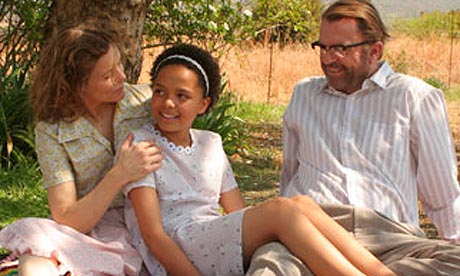
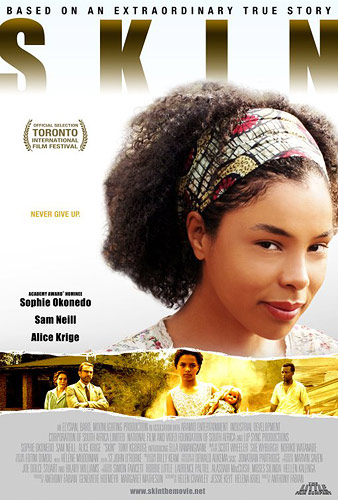
It is a rather strange coincidence that the British/South African film Skin, which is the story of a black woman born to white parents, is released in Australia in the same week that a black couple in the UK had a white baby. Like the recent British case that has made headlines all over the world, Skin features a similar occurence of what is known as genetic throwback (the influence of a relative further back on the family-tree producing a child with a different racial appearance to the parents). Based on the true story of Sandra Laing, who was born to white parents during Apartheid South Africa, Skin highlights the cruelty and arbitrary nature of segregation policies and the hypocrisies of South African society during this time.

The young Sandra (Ella Ramangwane) is sent by her loving parents to the exclusive boarding school that her brother Leon (Hannes Brummer) attends. Her strong-willed father Abraham (Sam Neill), with his own racial prejudices refuses to believe that his dark-skinned daughter will not be accepted at an all-white school. Sandra’s mother Sannie (Alice Krige) is more realistic about her daughter’s options, but bends to her husband’s will. Sandra’s treatment at the school is just the start of her life-time confusion and her mistreatment at the hands of the government and her family.

image

Sandra Laing’s case caused a change to South Africa’s racial laws during Apartheid, with classification of race decided to be determined by parentage not colour. In a society where one’s skin colour determined everything from where you could live, where you could work and who you could marry, Sandra’s life was made no better by an official declaration of her whiteness. Sandra’s teen and adult years (played by British actress, Sophie Okonedo), show the troubles she faced in finding acceptance in both black and white communities.

This is the first feature film for director Anthony Fabian, and at times this really shows with some substantial weaknesses to the film. The most problematic being the casting of Okonedo as both the teenage and adult Sandra. Okonedo is a fantastic actress, but watching her play the shy 17 yr old Sandra felt like a drama exercise.

Skin, while not the most accomplished film, is a story definitely worth telling. The tragedy of Sandra Laing’s life perfectly illustrates the cruelty of the Apartheid era, but also the idiocy of racism. This film questions notions of identity by examining the way that Sandra’s life became defined by the colour of her skin. Despite the film’s faults, Skin is an emotional and at times powerful look at a very sad period of South Africa’s recent history, told through the eyes of a survivor

image


First published on Trespass

Thursday, July 15, 2010

The Runaways


Musicians make excellent fodder for films, their stories more often than not involve youth, drugs, sex and fashion as well as the not insignificant aid of a ready-to-use soundtrack. The twist that The Runaways bring to this genre is gender. Together from 1975 to 1979, The Runaways were an all-girl American band. The teenage musicians had hits like Cherry Bomb, Queens of Noise and Born to be Bad. Even though their band-life was short, The Runaways are viewed to have been hugely influential, specifically for opening up the punk/rock music terrain for female artists. It is this story of girls gone wild, rebelling against convention and society that this film sets up, focusing on the relationship between lead singer, Cherie Currie (Dakota Fanning) and rhythm guitarist/songwriter, Joan Jett (Kristen Stewart).

Starting with the drummer, Sandy West (Stella Maeve, Transamerica) and Jett coming up with a musical style for a girl band and the search for a suitable lead singer, the film charts the formation of The Runaways, aided by music producer, Kim Fowley (Michael Shannon, Revolutionary Road). Showing the quick success of the band, specifically concerned with their 1977 sold out tour in Japan, the film highlights the impacts of drugs and in-fighting on its demise.

image

Director Floria Sigismondi, with her background in music videos has created a film that captures the grime and salaciousness of the story, without completely exploiting the characters within it (Fanning does seem to spend a large part of the film in underwear). The Runaways is certainly a visually stylish film, with the influences of glam rock and punk that the music extols- this is a film that is very much more concerned with attitude than truth.

There are definite scripting problems with The Runaways- most obviously the imbalance between the film’s central parts- partially due to the film’s source material- Cherie Currie’s book Neon Angels: Memoir of a Runaway. Slowly, but surely, attention shifts almost solely over to Currie, with far less time and interest given to Jett’s background or home life (interestingly Joan Jett is the Executive Producer on the film, so maybe that’s how she wanted it). However Jett’s slow edging out of the story is nothing compared to the limited representation of the rest of the band. Lead guitarist, Lita Ford (South Taylor Compton, Rob Zombies’ Halloween) and fictional bassist, Robin (Alia Shawkat, Whip It)- in reality the bassists changed over the years- turn up in the band without any explanation or background, in fact it is hard to remember if Shawkat even has a speaking part, Sandy West’s character fares a little better, but not much. The Runaways definitely feels like it narrowed the field of play down too far, so much so that it would be wrong to label this film as a biopic of the band.

image

You watch this film with partial wonder and partial concern. The exploitation of the group as ‘jailbait’ and specifically the manufacturing of Currie’s image as Lolita-eque sex kitten by Fowley undermines the ‘girl-power’ message of the band’s music. Shannon is fantastic as Fowley and does a fair amount of scene-stealing. Both Fanning and Stewart do well with the material, especially given the added component of singing and playing instruments. Stewart shows off a tougher persona than we usually see from her, proving she is far more than just a pout. Ultimately though the standout in the film is Fanning, who seems to be successfully transitioning from child to adult actor.


First Published at Trespass