Saturday, July 31, 2010

Skin


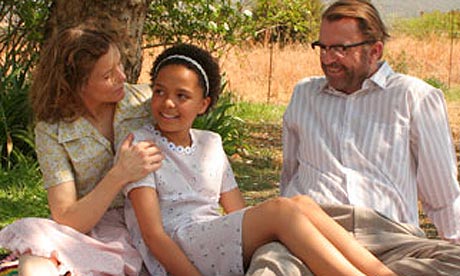
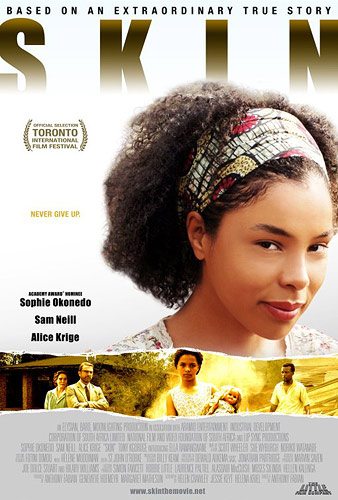
It is a rather strange coincidence that the British/South African film Skin, which is the story of a black woman born to white parents, is released in Australia in the same week that a black couple in the UK had a white baby. Like the recent British case that has made headlines all over the world, Skin features a similar occurence of what is known as genetic throwback (the influence of a relative further back on the family-tree producing a child with a different racial appearance to the parents). Based on the true story of Sandra Laing, who was born to white parents during Apartheid South Africa, Skin highlights the cruelty and arbitrary nature of segregation policies and the hypocrisies of South African society during this time.

The young Sandra (Ella Ramangwane) is sent by her loving parents to the exclusive boarding school that her brother Leon (Hannes Brummer) attends. Her strong-willed father Abraham (Sam Neill), with his own racial prejudices refuses to believe that his dark-skinned daughter will not be accepted at an all-white school. Sandra’s mother Sannie (Alice Krige) is more realistic about her daughter’s options, but bends to her husband’s will. Sandra’s treatment at the school is just the start of her life-time confusion and her mistreatment at the hands of the government and her family.

image

Sandra Laing’s case caused a change to South Africa’s racial laws during Apartheid, with classification of race decided to be determined by parentage not colour. In a society where one’s skin colour determined everything from where you could live, where you could work and who you could marry, Sandra’s life was made no better by an official declaration of her whiteness. Sandra’s teen and adult years (played by British actress, Sophie Okonedo), show the troubles she faced in finding acceptance in both black and white communities.

This is the first feature film for director Anthony Fabian, and at times this really shows with some substantial weaknesses to the film. The most problematic being the casting of Okonedo as both the teenage and adult Sandra. Okonedo is a fantastic actress, but watching her play the shy 17 yr old Sandra felt like a drama exercise.

Skin, while not the most accomplished film, is a story definitely worth telling. The tragedy of Sandra Laing’s life perfectly illustrates the cruelty of the Apartheid era, but also the idiocy of racism. This film questions notions of identity by examining the way that Sandra’s life became defined by the colour of her skin. Despite the film’s faults, Skin is an emotional and at times powerful look at a very sad period of South Africa’s recent history, told through the eyes of a survivor

image


First published on Trespass

Tuesday, July 27, 2010

Greenberg


Noam Baumbach has carved out a niche for himself examining the angst of being rich and white. Not as whimsical as Wes Anderson creations, Baumbach’s characters have a better awareness of their tics and neuroses. This more realistic approach makes his characters often unlikeable, setting up a much harder comedy to sell to audiences. With his latest film, Greenberg and the unpleasant title character, played by Ben Stiller, Baumbach has given himself his toughest challenge to date.

Roger Greenberg is a fortysomething, neurotic, self-centred jerk, who comes to L.A. to house-sit for his successful brother, Philip (Chris Messina) whilst he vacations with his family. Roger, recently released from a psychiatric unit, tries to use this time to reconnect with old friends and get his life in order, but as the film shows he is painfully out of his depth. Rather inexplicably twentysomething Florence (Greta Gerwig), Philip’s personal assistant, falls for Roger. It seems that maybe these two people, who are both treading water, might be a love match.

While Stiller’s performance is good, the film’s central character is far less engaging than the supporting cast. Greta Gerwig as Florence is a revelation. She almost makes you believe that someone as lovely and kind as Florence could fall for someone as truly charmless as Roger Greenberg. Also excellent is Rhys Ifans as Ivan Schrank, Greenberg’s supportive and tolerant friend. Ifans gives a fantastically understated performance, showing a character who has lived with similar disappointments to Roger, yet has managed to remain a happy functioning person.

Greenberg was written by Baumbach, with his wife- Jennifer Jason Leigh, who also has a small part in the film as Roger’s girl that got away, Beth. While the film is funny, clever and well-written it is also oddly unemotional. With an unrewarding central character the film lacks the ability to connect with audiences, many of whom will not want to spend time with the obnoxious Roger Greenberg. This is definitely a film for the already-Baumbach-converted.

First published in The Brag 19/07/10

Sunday, July 25, 2010

Inception


Christopher Nolan
(The Dark Knight) latest film Inception is a crime caper, sci-fi, arthouse, action film, which defies both categorisation and at times logic. This big budget production (reported to be between $USD 160-200 million) with a fantastic ensemble cast comes from the Memento mould of Nolan’s filmmaking, playing with story structure, time frames and realities. Inception is definitely one of those films where it is best to go into the cinema knowing as little as possible about what you are about to see (thankfully the advertising campaign for this film has been mercifully restrained).

Inception (without going into too much detail, I promise) utilises dreams as a terrain for action, with a story that simply put follows a reasonably traditional heist scenario. But really there is nothing simple about this film’s plot- the tangled and overlaying story-points are immensely convoluted, to the point that it is hard to decipher what exactly is going on, who it is happening to and why. Exposition in films is generally looked down on as laziness, but as both writer and director, Nolan can definitely not be accused of this. He has painstakingly not downplayed to his audience, expecting them to keep up with (or at least try to) the spiralling story.


Leonardo DiCaprio
plays the troubled Cobb, a man who goes on assignments to extract information from important people. His partner in crime is the level-headed Arthur (Joseph Gordon-Levitt, 500 Days of Summer). When a special case with huge rewards is presented to the pair by the powerful Saito (Ken Watanabe, Letters from Iwo Jima), they then join up with promising, young architect Ariadne (Ellen Page, Juno), talented liar Eames (Tom Hardy, Bronson) and chemist Yusef (Dileep Rao, Avatar) to plan and execute their perilous task. Added to this very strong central cast are seasoned performers Tom Berenger (Platoon), Pete Postlethwaite (The Usual Suspects) and Michael Caine (Harry Brown). Academy award-winning French actress, Marion Cotillard (Le Vie en Rose) and Irish actor, Cillian Murphy (Batman Begins) take on almost traditional roles within in the crime caper scenario, of femme fatale and the mark (victim.

Refusing to turn to CGI for all his visual wonder, Nolan has used mechanical effects for large sequences, with some amazing results. One particular scene revolving around Gordon-Levitt’s character is truly incredible to watch on the big screen. Special effects supervisor Chris Corbould, who worked with Nolan on the Batman films, and his stunt team have done an impressive and at times jaw-dropping job with the action in this film and deserve special mention.

With its visually spectacle (humongous and eye-straining if you watch this film at the IMAX) and its enticing storyline full of complexity, Inception also comes with a little bit of smugness, the film reveling in its measured insanity at time. But this is a small criticism in what is a massively successful film. Nolan’s triumph isn’t so much his tricky plotlines, but that he has carefully constructed the perfect film-going experience for audiences. Inception is amazing to look at, the cast includes actors/actresses that are not only popular but also critically acclaimed, and the film has an original script that forces audiences to pay constant attention (expect no toilet breaks) and leaves them pondering long after leaving the cinema. This is finally a big-budget film where the money feels well spent.


First published on Trespass

Friday, July 23, 2010

The Waiting City


The Waiting City follows childless Aussie couple, Fiona (Radha Mitchell, Rogue) and Ben (Joel Edgerton, Animal Kingdom) as they arrive in Kolkata to pick up their adopted daughter, Lakshmi. After 2 years of processing they discover, once in India, that additional bureaucracy means there is further delay to them becoming parents. It is this additional waiting that concerns the film.

The Waiting City is the first Australian feature to be shot entirely in India, allowing the film to examines the couple’s marriage in a foreign setting. By incorporating the mythical/spiritual elements of the film’s setting with the intensely intimate drama of the relationship this film captures the highs and lows of the couple’s journey with delicate honesty and emotional openness.

From the very outset of the film, when hard-working, tightly-wound lawyer Fiona and laid-back, muso Ben arrive in Kolkata Airport, you know that there is trouble in paradise. Organised Fiona takes it on herself to do everything and go-with-the-flow Ben abdicates responsibility to her, both are resentful of the roles they have drawn. They are picked up from the airport by affable hotel employee, Krishna (Samrat Chakrabarati, She Hates Me) who becomes the couple’s part-time tour guide. When their adoption plans don’t run smoothly the cracks in Fiona and Ben’s marriage begin to appear, aided by the appearance of beautiful, hippy musician Scarlett (Isabel Lucas, Daybreakers) and Fiona’s work commitments back in Australia.

image

Creating a wondrous sense of place, it is clichéd to say but, The Waiting City really does make a character of Kolkata. Viewed through the eyes of a tourist the city’s vibrant colours, sites and religious processions draw you into the film and help you to fall in love with India. The film does come close at time to over-romanticising the country, presenting an idealised spiritual culture, but Sydneysider writer/director Claire McCarthy (Cross Life) maintains the reins on the film so that the mysticism compliments the drama of the script.

The success of the film’s story and location is in no small part down to McCarthy’s familiarity with India and its orphanages. McCarthy documented her time working at Mother Teresa Missionaries of Charity in Kolkata with her younger sister Helena, in her 2008 film project, Sisters. It is from this time you image she met the templates for the characters in her film, like the serene Sister Tessila (Tilotamma Shome, Monsoon Wedding).

McCarthy and her team have taken the hot topic of inter-country adoption, which see the movement of children from developing to developed countries and have eased out the issues without heavy-handedness. The character of Krishna is used to express concern over this issue, as well as to widen the debate around notions of motherhood. This is a film that has a huge amount of compassion for its characters and even though it probes the couple’s relationship to find its cracks, it is also concerned with how these are mended. Mitchell and Edgerton bring such vulnerability to their characters, giving them a real depth that makes you completely invested in their emotional journey.

This is a film that takes its protagonists on a rollercoaster ride of emotions, mixing love, frustration, pain and joy. With its superb scripting, beautiful visuals and excellent performances, The Waiting City is one glorious ride I would be more than happy to take again.

image


First published at Trespass

Thursday, July 15, 2010

The Runaways


Musicians make excellent fodder for films, their stories more often than not involve youth, drugs, sex and fashion as well as the not insignificant aid of a ready-to-use soundtrack. The twist that The Runaways bring to this genre is gender. Together from 1975 to 1979, The Runaways were an all-girl American band. The teenage musicians had hits like Cherry Bomb, Queens of Noise and Born to be Bad. Even though their band-life was short, The Runaways are viewed to have been hugely influential, specifically for opening up the punk/rock music terrain for female artists. It is this story of girls gone wild, rebelling against convention and society that this film sets up, focusing on the relationship between lead singer, Cherie Currie (Dakota Fanning) and rhythm guitarist/songwriter, Joan Jett (Kristen Stewart).

Starting with the drummer, Sandy West (Stella Maeve, Transamerica) and Jett coming up with a musical style for a girl band and the search for a suitable lead singer, the film charts the formation of The Runaways, aided by music producer, Kim Fowley (Michael Shannon, Revolutionary Road). Showing the quick success of the band, specifically concerned with their 1977 sold out tour in Japan, the film highlights the impacts of drugs and in-fighting on its demise.

image

Director Floria Sigismondi, with her background in music videos has created a film that captures the grime and salaciousness of the story, without completely exploiting the characters within it (Fanning does seem to spend a large part of the film in underwear). The Runaways is certainly a visually stylish film, with the influences of glam rock and punk that the music extols- this is a film that is very much more concerned with attitude than truth.

There are definite scripting problems with The Runaways- most obviously the imbalance between the film’s central parts- partially due to the film’s source material- Cherie Currie’s book Neon Angels: Memoir of a Runaway. Slowly, but surely, attention shifts almost solely over to Currie, with far less time and interest given to Jett’s background or home life (interestingly Joan Jett is the Executive Producer on the film, so maybe that’s how she wanted it). However Jett’s slow edging out of the story is nothing compared to the limited representation of the rest of the band. Lead guitarist, Lita Ford (South Taylor Compton, Rob Zombies’ Halloween) and fictional bassist, Robin (Alia Shawkat, Whip It)- in reality the bassists changed over the years- turn up in the band without any explanation or background, in fact it is hard to remember if Shawkat even has a speaking part, Sandy West’s character fares a little better, but not much. The Runaways definitely feels like it narrowed the field of play down too far, so much so that it would be wrong to label this film as a biopic of the band.

image

You watch this film with partial wonder and partial concern. The exploitation of the group as ‘jailbait’ and specifically the manufacturing of Currie’s image as Lolita-eque sex kitten by Fowley undermines the ‘girl-power’ message of the band’s music. Shannon is fantastic as Fowley and does a fair amount of scene-stealing. Both Fanning and Stewart do well with the material, especially given the added component of singing and playing instruments. Stewart shows off a tougher persona than we usually see from her, proving she is far more than just a pout. Ultimately though the standout in the film is Fanning, who seems to be successfully transitioning from child to adult actor.


First Published at Trespass

Wednesday, July 14, 2010

Creation

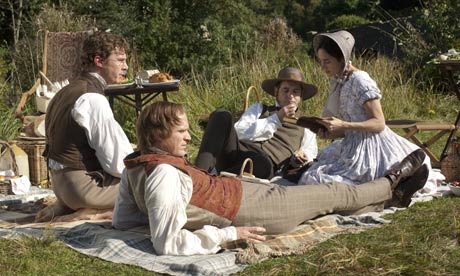
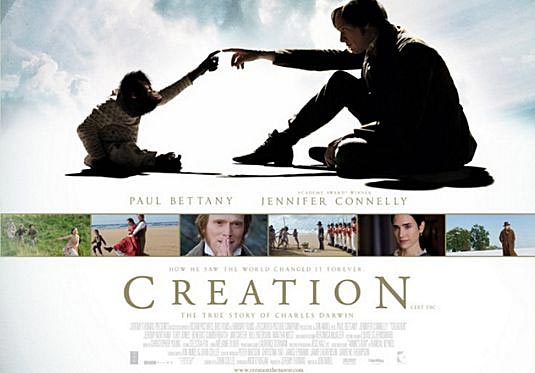
There are few people today who are unfamiliar with Darwin’s theory of evolution, expressed in his seminal work On the Origin of Species, which celebrated its 150th anniversary last year (2009). But how much do we know about the man Charles Darwin? The husband and father whose research forced a fundamental shift in thinking? Creation has been adapted from the book Annie’s Box, written by British conservationist, Randal Keynes (Darwin’s great great grandson) and looks to give audiences a glimpse into the personal life of Darwin.

The film focuses on Darwin’s (Paul Bettany, Legion) relationship with his eldest daughter, Annie (Martha West, daughter of The Wire’s Dominic West) who tragically died at the age of 10. Darwin’s grief affects both his physical and mental health. He is paralysed, caught between science, his empirical findings and religion, part of his family life. Charles’ loving wife, Emma (played by Bettany’s real-life wife, Jennifer Connelly, House of Sand and Fog), is unwaiving in her religious beliefs and this causes her to not only worry about her husband’s deteriorating condition, but also his potential eternal resting place.

image

British director Jon Amiel (The Core, The Man who Knew Too Little) glorifies nature throughout the film, with enhanced scenes of the natural world, emphasised in vivid colours. The wonder of nature is in sharp contrast to the darkening gloom of Darwin’s mind. Haunted by guilt, real and imagined, Darwin seems to be living a life in limbo-caught in memories of happier times.

Creation is also a film concerned with storytelling. Darwin at times proves to be an enthralling narrator, as he tells tales from his explorations and studies- that seem to highlight the best-intentioned, tragedy of Western men’s interference with nature. These sections are some of the most engaging parts of the film.

This insight into Darwin’s life, specifically the idea that during this period his professional and personal life were drawn in vastly different directions, is fascinating. But Creation seems preoccupied with the family drama unsure how to balance in the science. Without bringing in the broader frames of reference, hinted at in the roles of Benedict Cumberbatch (Joseph Hooker, Atonement) and Thomas Huxley (Toby Jones, Infamous), the film at time struggles with the religion vs science debate it has set up. But Creation is by no means a wash out. With solid performances, this film provides an interesting alternative look at one of the most influential scientists of the modern era.

image


First published on Trespass
Saturday, July 10, 2010

Predators

Some franchises never die or as the film’s tagline puts it ‘Fear is Reborn’; the evil, hunting-hobbyist aliens- Predators- are back for another go in 2010. The film that started it all, Predator was released in 1987 and starred Arnold Schwarzenegger as a the leader of an elite team of commandos sent to a Central American jungle on a CIA task. There they are picked off one-by-one by a seemingly invisible foe. Since the success of the first film there has been the disappointing sequel- Predators 2 (1990) and then a reboot of the franchise with Alien vs. Predator (2004) and Alien vs. Predator- Requiem (2007) which introduced a mythology for the intergalactic, heavily armed travellers.

In a return to the sensibilities of the original film, Predators, which comes as a sort of sequel to the Arnie classic, follows a group of multicultural strangers who find themselves on an alien recreational hunting ground where they are the prey. Predators starts with a truly clever and original sequence that brings all the culturally diverse players together in a foreign jungle. Adrien Brody (The Pianist, The Brothers Bloom), with a gravelly voice and a six-pack, plays Royce- a mercenary who becomes the group’s tactical leader, he is joined by: Isabelle (Alice Braga, City of God, Blindness) an Israeli sniper; Cuchillo (Danny Trejo, From Dusk til Dawn), a Mexican drug gang enforcer; Nikolai (former UFC Champion, Oleg Taktarov), a member of Russia’s special forces; Mombasa (Mahershalalhashbaz Ali, The Curious Case of Benjamin Button), a member of a Sierra Leone death squad; Stans (Walton Goggins, The Shield) an American death row prisoner; Edwin (Topher Grace, That 70s Show), an American doctor and Hanzo (Louis Ozawa Changchien, Gigantic), a Yukuza hitman.

Predators works best at 80s action level, with its predictable death toll and conforming racial stereotypes (echoed from the original film). The film is comforting in its conventions with its cheesy one-liners and elaborate set-pieces. However there really isn’t enough of this over-the-top fun to grasp onto with the film being heavily reliant on exposition. There are too many scenes designed to explain the rules of the film. The majority of viewers will already know the attributes of the Predator species from previous films, and for those who don’t- it’s hardly rocket science. Director Nimród Antal spends too much time telling the audience what is going on and not enough time showing us.

This film needed more killing and suspense and less Brody monologues. Yes he is an Oscar-winning actor, but this film should have been blood and guts, without the sanctimonious dribble about man’s propensity for violence. With so much of the film taken up by character development, the title Predators don’t really get much time on screen (invisible or not), leaving the film largely devoid of suspense. With the script also relying on unnecessary self-sacrifice to push the story forwards, this film shows how hard it is to make a good B-grade movie.


image

Antal’s (who has been hidden behind producer Robert Rodriguez in all the advertising) take on the Predator franchise is a little too light. This is the kind of film you go to expecting gore and shocks, ultimately these two elements, along with the predators themselves, are sadly awol in this latest version.


First published on Trespass