Showing posts with label French Film Festival. Show all posts

Thursday, March 24, 2011

French Film Festival Preview

Carlos/Le Chacal

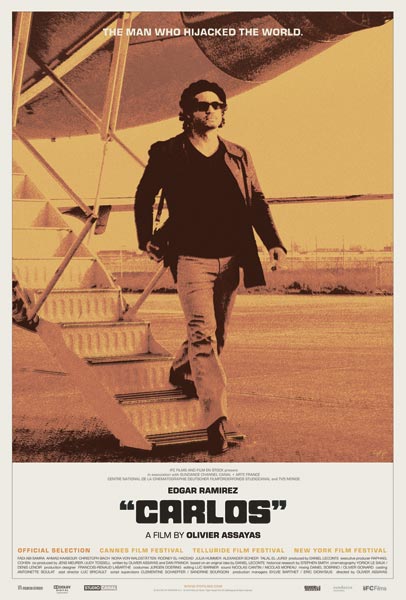
Olivier Assayas‘ (Summer Hours) Carlos was originally shot and cut as a five and a half hours TV miniseries (which won Best Miniseries or Motion Picture Made for Television at the Globe Globes 2010), it has since been cut down to a two and a half hour film, and this is the version screening at the FFF. Looking at the exploits of infamous Venezuelan terrorist/revolutionary Ilich Ramirez Sanchez, this film paints a very negative picture of the man who is better known as Carlos the Jackal (Edgar Ramirez,The Bourne Ultimatum).

At the beginning of the film we see a very confident young Carlos travel to Beirut to join The Popular Front for the Liberation of Palestine (PFLP) in 1970. We follow Carlos up until his 1994 capture and arrest in Khartoum, Sudan. Throughout this time although Carlos’ alliances chop and change as he is involved in European communism, Arab nationalism and Islamist causes, his revolutionary persona grows to iconic proportions as he become the poster-boy for international terrorism through the 70s and 80s.

Early on in the film during a heated debate Carlos is told by another Venezuelan revolutionary “That’s what you want-to be admired.”. Shown as an egotist and a chauvinist, Carlos’ commitment to ‘the cause’ is perfectly highlighted by his involvement in the 1975 OPEC raid where he shows himself to be both self-serving and self-preserving.

Travelling between many countries and covering the geopolitics of three decades the film picks up the many hypocrisies of the regimes and organisations Carlos is associated with; such as the PFLP leader who couldn’t care less about the persecution of the Kurds in Iraq, or the German communists debating the difference between anti-semitism and anti-zionism.

Carlos (Edgar Ramirez)

Refusing to allow in any of the idealisation of Soderbergh’s Che (2008) films, Assayas presents a man whose narcissism sees him go from idealistic revolutionary to public enemy number one and whose vanity ultimately places him as a forgotten page in Cold War history. Edgar Ramirez’ performance as Carlos is, of course, the glue that holds the film together. Playing the Lothario revolutionary, the gun-obsessed criminal and the image-conscience terrorist, Ramirez beautifully executes all Carlos’ personas giving us the man behind the myth.

On Tour/ Tournée

Mathieu Almaric (Quantum of Solace, The Diving Bell and the Butterfly) directs and stars in this film about an American Burlesque troupe on tour in Western France. Almaric plays Joachim a failed Parisian TV producer, who is hoping for a triumphant return to France after a stint in America. Joachim has brought five American burlesque performers with him for a pre-arranged tour of Coastal France. It isn’t long before plans start to fall apart and Joachim isn’t living up to the performers’ expectations.

This very loosely scripted film stars real-life New York performers such as Dirty Martini, Julie Atlas Muz andMimi le Meaux. Practitioners of what is called Neo-Burlesque, these buxom and bawdy women define their style of performance as ‘women doing burlesque for women’. As the troupe travels from chain hotel to chain hotel, performing at less and less glamourous theatres, the film shows the growing tension between the group and the sardonic Joachim, who moves between charm and insult in dealing with his unruly American performers.

Director and star Mathieu Almaric with his Burlesque stars

Filmed in both English and French, On Tour is one of those great films which offers you a little slice of life, without much concern for plot or cinematic polish. Almaric is fantastic as the weasely promoter, Joachim, who having burnt all his bridges before going to America tries rather unsuccessfully to reunite with former colleagues, friends and his children. But somehow this almost pathetic character is also likeable and his genuine respect for the burlesque performances and his desperate attempts to keep everything on track are endearing. There is a particularly lovely throwaway scene between Joachim and a petrol station attendant (played by Aurélia Petit) with a delightfully playful dialogue that highlights Almaric’s talents as a filmmaker.

Winning best director as the Cannes Film Festival in 2010 for this film, Almaric’s naturalistic approach to filmmaking serves him very well in this setting. While the acting performances of the burlesque artists aren’t always convincing, their unique and sassy personalities win you over. This witty, saucy and rambunctious film is a refreshing change of pace to conventional cinema fare.

My Father’s Guests/ Les Invitiés de mon Père

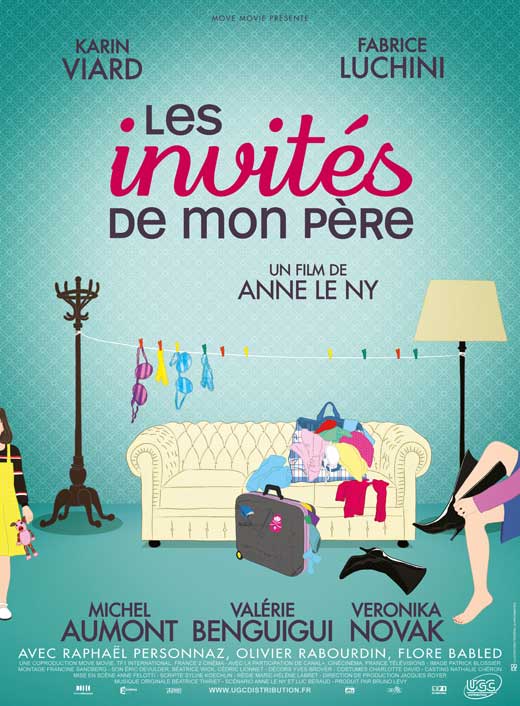
Actor turned director Anne Le Ny (Those who Remain/ Ceux qui Restant) gives us a tale of immigration and family in modern France with her second film, My Father’s Guests.This comedy takes more than a few pot-shots at bleeding heart liberals as it looks at the difference between rhetoric and practice. Focusing on a well-to-do middle class Parisian family, the film looks at the dynamics between middle-aged siblings Babette (Karin Viard) and Arnaud (Fabrice Luchini) and their 80-year old father Lucien (Michel Aumont).

When ageing humanitarian Lucien decides to open his doors to some illegal immigrants, his family is split in their reactions. While his G.P. daughter and daddy’s girl Babette and his politically active granddaughter (Flore Babled) applaud his decision, his rich lawyer son and daughter-in-law are less impressed with the idea. However when the family find out Lucien has married a beautiful 28-year old Moldovan refugee, Tatiana (Veronica Novak) to allow her and her young daughter to stay in the country, the family have trouble reconciling this reality with the image of the illegal immigrants they were expecting. As Tatiana’s behaviour towards their father begins to look suspicious, Babette and Arnaud connect over their distrust.

While Le Ny and co-scriptwriter Luc Béraud start out initially giving us as a satirical comedy exploring the values of Paris’ bourgeoisie and poking fun at their left-leanings views, there is definitely a mood shift about half-way through the film and the immigration aspect that has been used to fuel the comedy is buried for the more fruitful topic of family.

Arnaud (Fabrice Luchini) and Babette (Karin Viard)

Viard and Luchini have a great chemistry as brother and sister, whose father’s increasingly worrying behaviour sees them growing closer. Veronica Novak also gives a great performance as the tough-as-nails Eastern European immigrant. In a film that offers ample opportunity to laugh at the characters and their mores, it is Tatiana’s story which will give audiences the most trouble with the moral ambiguity which is offered by Le Ny, but never resolved.

Images 1,2,3,4,5,6

First published on Trespass

Sunday, September 5, 2010

Father of My Children


Young French filmmaker Mia Hansen-Løve won the Cannes Special Jury Prize in 2009 for her sophomore film (which she wrote and directed), Father of My Children/ Le père de mes enfants. The film, inspired partially by the life of French film producer Humbert Balsan, follows the fictional character of Grégoire Canvel (Louis-Do de Lencquesaing) who runs a small company producing art-house films, and has a loving family with supportive Italian wife Sylvia (Chiara Caselli). Behind the happy façade everything is not quite as rosy as it seems and increasing financial debt pushes Canvel to drastic action.

This French film offers a fascinating insight into the mechanics of independent filmmaking, the nitty-gritty of financing and location hunting. The role of producer is one that is frequently vilified as someone concerned with money not art and here in this film, Hansen-Løve shows the dedication and passion of small production companies, like the film’s fictional Moon Films, that enable less commercially appealing films to be made. Canvel may not be a very good businessman, but his commitment to filmmaking is unquestionable. Louis-Do de Lencquesaing imbues Canvel with charisma, giving the character instantly likeable, which makes the slow crushing of his spirit by his financial woes all the more affecting.

Along with the family of colleagues that Canvel has built up at his company, the film also shows the idyllic home life that Canvel shares with his wife and children- the increasingly independent eldest daughter Clémence (Alice de Lencquesaing), and two exuberant younger daughters Valentine (Alice Gautier) and Billie (Manelle Driss). These three young actresses give the film its heart. Gautier and Driss are fantastic as these two switched on, adorable youngsters. Alice de Lencquesaing, who was impressive in her small role in 2008’s Summer Hours, is compelling to watch on screen with her character’s getting its own rewarding emancipation story arc.


Father of My Children tackles a heavy subject matter without being weighed down by the topic. Hansen-Løve could have easily made this film a cry-fest, but instead focuses on the strength of the family giving us a moving and charming film, instead of an emotionally fraught one. The subtle, tender sadness of the film trumps any of its small scripting problems and certainly marks out not only the film’s young cast members but also the director as ones to watch.

Images
1,2

First published on Trespass

Monday, April 19, 2010

Jan Kounen Interview- Coco Chanel and Igor Stravinsky

image

Music + fashion = grand passion.

Dutch-born French director, Jan Kounen recently travelled to Australia to promote his beautiful Art Deco film, Coco Chanel & Igor Stravinsky. With a back catalogue including the ultra violent Dobermann, and the Shaman-injected western Blueberry, this adaptation of Chris Greenhalgh’s novel about a passionate affair between two Twentieth Century icons seems like an unusual choice for the Kounen.

"I received Coco & Igor and it was a complete opposite project for me, but it was resonating with me, really strongly, because it was completely challenging me. It’s not the universe that I knew."

Kounen was eager to take the project when he heard that Danish actor, Mads Mikkelsen was attached. "I wanted to work with him, because of his Danish work, his Danish films that I love, After the Wedding, Pusher, Adam’s Apple."

But it is the character of Coco (played by Anna Mouglalis) that seems to have inspired Kounen the most, "My feeling is that she is a century ahead in terms of her vision for women. She had her own business, she had freedom, she was a feminist. She had a vision of modernity, to see ahead, to sell herself as a brand." But Kounen is quick to point out that his film shows all the shades of Coco’s character "At the beginning you she her manipulating as a dark queen, bringing the family [to her house] to get [Stravinsky], but later you see something else, it’s not black and white."

The film focuses on the summer of 1920 when Stravinsky and his family stayed at Coco’s villa, Bel Respiro. Little is known about what actually happened between the designer and composer "You know that they’ve been lovers, you know who they were, who they were psychologically. You have books, information through the music, what they feel. You have all that. But from there, the rest is invention."

And just when it sounds like Kounen has gone mainstream, his fascination with mystical matters works its way back into the discussion. "Are [Coco & Igor] around, and feeling that maybe they’d like this film or not? You know I’ve done [the documentary] Darshan about a Hindu saint, I’ve done a film about traditional medicine. I can’t help having a drift to mystical realms; but when I saw this movie [Coco & Igor] I thought absolutely not. But suddenly the mystic came back".

Kounen remembers a spooky case of coincidence with glee: "I was going in the car to Grasse, for the first day of shooting, with only Coco. I put on the radio and there was the Rite of Spring, and they say ‘and now the Rite of Spring from Igor Stravinsky’. I never hear Rite on the radio like that. I felt that the character [Stravinsky] is speaking to me - ‘You forget me!’"

Surprisingly perhaps, Kounen is most enthusiastic, when discussing his 2007 short film The Story of Panshin Beka. Made as part of the portmanteau film 8: No Time Left (which includes shorts by Gus Van Sant, Jane Campion and Wim Wenders, among others), the affecting black and white short puts the spotlight on maternal health. "I think this problem resonates with me, because my grandmother died giving birth to my mother, " Kounen explains- "and because that still happens today in some areas of the world."

Shot with the Shipibo Indian tribe, whom Kounen has been linked with for years now, it is obviously a film that he treasures "My favourite film, you can put that down, my favourite one. But I love Coco and Igor."


Published in The Brag and Beat 12/04/10

Monday, April 5, 2010

Interview with Philippe Lioret-Welcome

image

Welcome is a devastating look at the refugee situation in France. The film is set in the coastal town of Calais, where makeshift refugee camps have been erected by young Middle Eastern men stuck in limbo. They can see the Dover cliffs, but only desperate measures can get them across the Channel. Director and screenwriter Philippe Lioret travelled to Sydney during the French Film Festival, where he spoke passionately about the issue.

"When I heard about the problem I thought immediately that it could be a good theme for a good drama. I’m not politician, I’m not lawyer, I’m only a filmmaker and my only idea was to do a good film, with a good subject." Lioret spent six weeks researching the subject. "I spent a long time with [the refugees], I was with them nearly in the trucks. When you see it with your eyes, you can write it exactly like it is. If you write something you never see, you invent and you sometimes overdramatise."

Welcome takes you into the hidden world of refugees, from fraught attempts to smuggle themselves to England in freight trucks, to the demeaning procedure of being tagged by the local police when they are caught.

"They are human beings and they are treated like animals," Lioret exclaims, his frustration palpable. "They are only saving their life. I saw many of them thirteen, fourteen years old, the parents in Afghanistan give money to traffickers so that their boy could escape this country. They are only escaping from war."

At the heart of Lioret’s story is newcomer Firat Ayverdi, who plays the quietly determined Bilal, a teenage Kurdish refugee, who is desperate to join his girlfriend, in the UK. It was a role Lioret wasn’t sure he was going to be able to fill "you don’t know if Bilal exists somewhere in the world. He must be seventeen, speaking Kurdish and also speaking English, and be a young boy from one foot and an adult from the other, and he must be so charismatic that he could be a main character". In a twist of fate, Lioret stumbled across Firat, who had never acted before, when he cast his sister (Derya Ayverdi) to play Mina.

Lioret took a chance "after two scenes of test, each time I looked at the video he was touching me. I said ‘okay Firat if you want, you do the main character’, but I was trembling, I wasn’t sure he could, but you must take the risk". The role of Bilal is physical, involving a lot of swimming. Lioret realised how lucky he had been when he found out Firat played water polo. "Do you know a Kurdish water-poloist? He may be the only one in the world".

Welcome calls for change, and Lioret has been outspoken about the French law that makes helping an illegal immigrant a jailable offence. Lioret’s cause was buoyed by a rare film award. "After the film went to the European parliament we got the Lux prize. And the Lux prize of the European Parliament means that the European Parliament says to the French parliament, this law is unfair."

Welcome is a beautiful film about an ugly issue. The refugee question is undeniably complex, and the director doesn’t have any easy answers "My opinion is that you must not teach something to the audience, you must only show a film. And if they get emotion, if they love the film, when they leave the cinema and they cross the street, if something stays in the brain, it’s okay."


image


Published in The Brag 29/03/10

Sunday, February 28, 2010

French Film Festival Preview

image

Now in its 21st year, the French Film Festival starts in Sydney and Melbourne this week, with other cities to follow. As part of Trespass preview for the festival I picked some film highlights from the program, some I've had the pleasure to see already, and some I'm desperate to see.


Micmacs/ Micmacs À Tire-Larigot

image


This latest comedy from director Jean-Pierre Jeunet (of Amélie and Delicatessen fame) again looks at a group of misfits. The story follows the unlucky Bazil (Dany Boon), who is left with a bullet lodged in his brain after an accident. He teams up with an eclectic mix of scavengers to seek revenge on the weapon manufacturers who have caused him such pain. With the director’s usual sense of quirky humour, the film creates a charmingly detailed world in which the action unfolds.


I’m Glad my Mother is Alive/ Je suis Heureux que ma Mère soit Vivante


Co-directed by father and son, Claude and Nathan Miller, the film was originally in the hands of Jacques Audiard (A Prophet), who stayed on as a producer. Based on an article by Emmanuel Carrère, taken from a real-life incident involving an adopted boy finding his birth mother and the unexpected results, the film was heavily praised at the recent Venice Film Festival. Be prepared for a thought-provoking film, without easy answers.


White Material


Starring the always amazing Isabelle Huppert (The Piano Player, 8 Women, Time of the Wolf), White Material is director Claire Denis’ (Chocolat) long-awaited return to Africa. Denis’ inspiration for the film has come from newspapers stories about white farmers in Zimbabwe and Kenya and civil wars in Sierra Leone and Liberia. Taking place during the chaos of a civil and racial conflict, the film is set around a coffee plantation in an unnamed country. Denis’ central characters must make survival choices as the social structures around them collapse.

So disappointed White Material isn't screening in Sydney, fingers-crossed the rumours about its inclusion in the Sydney Film Festival are true.


Gainsbourg: Je T’aime…. Moi non Plus/ Gainsbourg (Vie héroïque)


Screening as the Festival’s closing night Gala, this Gainsbourg biopic is the directorial debut of graphic novelist Joann Sfar. Starring Eric Elmosnino as the iconic singer, Serge Gainsbourg, the film traces his life- from growing up in Nazi-occupied Paris to the height of his success as a singer/songwriter. Included in the film is Gainsbourg’s notorious womanising, highlighted by his relationships with Brigette Bardot and Jane Birkin, among others.

Welcome


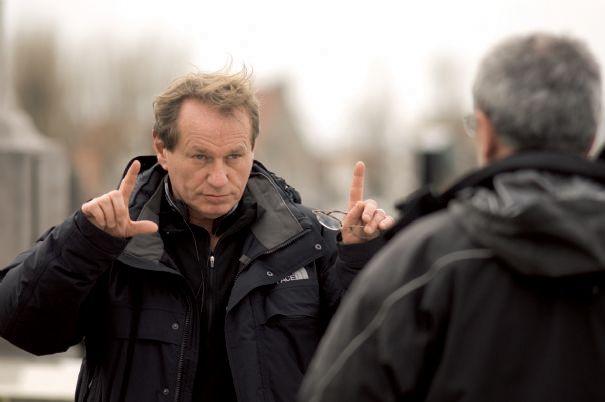
The less you know about Philippe Lioret’s critically acclaimed film before watching it, the better. With strong political and social commentary, Welcome explores France’s treatment of refugees using a story of friendship between two men who both feel the pain of lost love and dislocation. Starring Vincent Lindon as Simon and new-comer Firat Ayverdi as Bilal, the film captures the devastating reality of France’s hard-line policies. With some screenings including a Q&A with the director, this is a fantastic opportunity to learn more about the film whose success in France put increased public pressure on Nicolas Sarkozy.

Click here to read the full piece at Trespass