Showing posts with label Interview. Show all posts

Wednesday, January 5, 2011

Talking Genre Politics with Patrick Hughes

Red Hill marks Australian filmmaker Patrick Hughes feature film directorial and writing debut. Red Hill, a modern Australian Western, had its world premiere at the Berlin Film Festival earlier this year. The film’s action unfolds over one day and night in a small town in Victoria. Ryan Kwanten stars as Shane Cooper, a city cop who has just relocated to the country town of Red Hill. Cooper’s first day turns into a nightmare when convicted murderer Jimmy Conway (Tom E. Lewis) escapes from prison and returns to town seeking revenge against the lawmen who imprisoned him, including Old Bill (Steve Bisley).

Beth Wilson caught up with Hughes on the publicity trail to find out more about his transition from short films and commercials to feature films, the inspiration for the film and to talk about the dirty word ‘genre’…

Red Hill has been called a Western and a return to the heyday of Australia’s 70s and 80s genre films, how would you describe your film and its film genre?

I like to call it a neo-Western. It’s a modern take on old themes. Certainly I was inspired by the landscapes and the town we shot the film in, I found something that was really tragic about the story of a town, a boomtown that has gone bust. It is an old town that has lost its way in a modern world and it’s fighting for its survival, and it is fighting for a position and a sense of identity. You look at a town like Omeo (where Red Hill was filmed) it used to have 40,000 people, in 1890 it was Australia’s biggest gold rush town, Now there are 120 and all those industries have shut down. What happens to all those people left? How far will they go to save their town? I found that was a really interesting starting point in terms of creating a modern-day Western.

So the story started with that town?

I was fortunate enough to do some Brumby chasing when I was younger with a character that lived up in that town named Ken Connelly, and I remember riding back through the main street of Omeo, and I literally felt I was in a living breathing Western. I remember riding on horseback and you’d pass the town hall, barbershop and rickety old shopfronts and then a Toyota Landcrusier drives past and no one flinches because it is the kind of town where there still is that mix of horses and cars. It felt like you were in a lost world, felt like you were walking through a museum.

I am a huge fan of what every western is, which is a moral code. Red Hill is an exploration of revenge, redemption and sacrifice, and then you look at the history of our country. I grew up watching all these Westerns and if you look at the colonialisation of America, and the white man moving in pushing the American Indians out and the terrible atrocities that happened, the parallels to our country are striking. Exactly the same thing happened here when the white man moved in and pushed the Indigenous people off their own land. I felt like if anyone is due for a story of revenge it would be the Indigenous people of Australia.

You have had a career making commercials and highly successful shorts, how did you find the transition to your first feature film, where you had a budget that was less than you’ve had previously for commercials?

Every time I’m on set I’m learning. I think commercials are a really great training ground to learn the physicalities of how a set operates. Knowing how fast you can move, and I like to shot fast and move fast, obviously with Red Hill we had four weeks to shoot the movie; some people would go “you’re nuts, you’re crazy” but I knew in the back of my mind that we had a real chance of pulling this off. What commercials have allowed me to do is bring in an incredibly gifted crew. These guys are some of the best people in the industry, they’ve worked on some of the biggest films, you know all the Hollywood blockbusters they shoot out here.

We ended up with a situation where if we could just get a really great cast and a really great team of crew and just get them into the high country, in this one town for four weeks, we could pull off a movie, and that was kind of how I did it.

How did you go about casting?

It is tricky as an independent filmmaker because you don’t have a studio behind you or any major resources, so I’d written the script, but I had to raise the money before I could approach the actors, because you don’t want to waste their time. You want to give them a cemented date. Once I’d written the script I then raised the money privately and once we had, that first port of call was casting the three leads.

Steve Bisley was my first choice and I got the script in front of him and we immediately hit it off. Then Tom E. Lewis, I was really terrified about sending him the material, because you know the assumptions people make about who the bad guy is. You know you’ve got a disfigured Indigenous person wielding a sawn-off shotgun and sweeping through a small country town, it is pretty confronting material. So before I gave Tom E. the script I said please don’t throw this in the bin at page 50 because you won’t know the full story, don’t make any assumptions. God bless him he didn’t and he called me the next morning. And Ryan [Kwanten] of course, I was looking for an actor who had a strong physical presence but also had a vulnerability, because essentially the film is the story of a city boy who needs to become a cowboy. Once I’d cast those three leads I knew I had a real movie. I’ve got two iconic legends of Australian cinema, Steve Bisley and Tom E. Lewis, obviously Ryan Kwanten is just a raw talent, he literally walked off the second series of True Blood and onto our set.

Because it was independently funded did that mean it felt like you had more creative control?

I mean the only reason you make your first movie is so someone lets you make another one. I know that I’ll look back in 20 years and say the most fun I probably ever had making a movie was shootingRed Hill, because we literally made it outside of the system. No one even knew we were up there shooting it, it felt like we were in this little bubble. It was a really surreal experience when you are standing on set at 3 am setting fire to a house, or doing all the crazy stuff we did with the car chases and shoot outs and we felt we had the whole town behind us and there was a real kind of team spirit up there.

There has been a lot of talk in Australian film circles that Australia needs more genre films, which you have provided. But are you worried at all that Australian audiences are notoriously bad at watching Australian films?

Yeah, but I think if we consistently keep on making better films then we’ll probably win them back. I don’t know if one film is going to turn it all around, I don’t think it is that simple. It does feel like maybe we lost our way for a while, we lost our audience for a while we certainly did that. How do we win them back? I think if we start making films of all different types of genres. That is really important too, not to just keep making the same kind of films.

Everyone walks around saying genre is a dirty word. I think it is ridiculous, because I think if you look at every kitchen sink drama, they are a genre to themselves, they all hit the same marks every time. If it is the fish out of water, the story of someone who has come back to bury their father in a small country town- I’ve seen that a million times. Name me one film that isn’t a genre movie.

But it is a term that holds connotations…

I think what people apply it to is making commercial films. I made this film because it is really something I’d like to see, I hope it transpires to box office figures. I think if filmmakers keep questioning who’s the audience for this film, then slowly piece by piece we might just win that audience back. I think there is a lot of distrust out there. The marketing can push it so far but to get that real pop you need to get the word of mouth and the buzz from people on the street. More than anything I’ll respect what my friend says “hey man you’ve got to go check out this movie”, at the end of the day that is what it comes down to.

That’s what we want more Aussies watching Aussie films

And if they don’t go and see it I’ll cut loose with a sawn-off shotgun. I’m serious I’ve got my gun licence. (he’s NOT serious)

Images provided courtesy of Sony Pictures Au

First Published on Trespass 18/11/2010

Tuesday, November 23, 2010

Josh Fox Interview

An interesting episode in the life of Josh Fox

Josh Fox, US documentary-maker and current mouthpiece of the anti-natural gas drilling movement, has been on what he calls “an exhausting and comprehensive” tour with his film, GasLand. Launching screenings with local grassroot organisations across America and then travelling to Australia for Q&As in Brisbane, Sydney and Melbourne, Fox’s role is one firmly stuck between filmmaker and activist. Tired but still obviously spurred on by the environmental damage he’s seen and the threat to his own home, Fox is determined to continue spreading the message of the film.

GasLand is part exposé, part personal travelogue. The project began when Fox received a letter from a gas company offering $100,000 to lease part of his family’s upstate New York estate for exploration. Instead of signing on the bottom line like many of his neighbours Fox- a theatre director and part-time banjo player- decided to investigate the natural gas industry. “I was in the middle of a raging debate in my area between people who wanted this development and people who didn’t, and I just wanted to find out who was right.”

At the outset of his journey Fox was oblivious to the extend of the damage that hydraulic fracturing (a process for drilling for gas) was causing across America. It was a trip to the town of Dimock, Pennsylvania (shown in the film) that spurred Fox on to action. Interviews with residents there revealed flammable drinking water polluted by chemicals involved in the drilling process and massive health problems caused by toxic emissions. Fox felt terrified.

“I came home [after visiting Dimock] and I couldn’t sleep for a month, I still can’t sleep sometimes when I think about it, because I feel the walls closing in and I feel like I might have to leave.” Indeed, Fox's greatest fear is that he may not ultimately be able to halt the drilling process. “Here I am down in the valley, a lot of the property up on the hill, to the north side is leased. My immediate neighbours to my left and to my right are not leased, but what if they sell their house and the next person leases? … Even if they just drill the properties up on the hill, all those toxic emissions, and I know what they are, are going to waft down and collect in the valley.”

Watching GasLand it is hard not to feel outraged and angry. The film shows how gas companies in the US have been allowed to by-pass environmental laws. But despite all of his alarming and depressing findings you never see Fox angry in the film, which is surprising. “I think I am in shock myself a little bit about that, I think I am really deeply angry, I don’t think that is the way to express it though.” Fox pauses before continuing “Here is the thing, I think you have to leave space for your audience to make up their own mind… GasLand is a series of questions, put forward from a reasonable perspective, and it is in the audience’s hands to figure out what they need to do or what they think. You’ve got to come charging in at the end of the movie, not me, I’m already charging.”

Converting audience outrage into action isn’t easily done, but this filmmakers isn’t shy about pointing the way. “I think people have to be in the streets protesting about this, in the major cities. I think you have to have, at the locations, civil disobedience. The popular opinion has to turn and say ‘no, we are citizens of this country and we really want to examine this before industry comes in and decides to buys out our continent and our government’. At the beginning of the process I was really interested in preserving my land and my house, now the most important objective to me is to move the Earth towards renewable energy. Its about all of us investing in the great change that is to come, which is to get off fossil fuels. And natural gas is dirty just like fossil fuels.”

Perhaps unsurprisingly, Fox has attracted a smear campaign determined to discredit both him and the film. “A lot of people have said ‘hey you are getting to them, they’re attacking you’. But it sucks. Here is the thing that bothers me about it, what they [gas companies] are saying is so obviously a lie, they are lying through their teeth. I would like to see journalists challenge them on their lies instead of me having to deal with it. When they come out and say ‘We’re not exempt from the Safe Drinking Act’ the rudimentary level journalist could just look it up and see they are lying. And if they try and put that question to me, the journalists should chime in and say ‘sorry we know you are lying’. That’s is the part of it that pisses me off, the fact that they are able to hit one spin cycle in the media and disrupt the conversation with something that is such an obvious untruth.”

Becoming the mouthpiece of a cause certainly doesn’t come without its problems, but Fox with his wry sense of humour, seems to be coping. “The film has put the human face on this issue, on gas drilling…For me it is a really interesting rollercoaster. Isn’t this an interesting episode in the life of Josh Fox, I wonder what will happen next?”

First published in The Brag 15/11/10

Images 1,2,3

Monday, November 15, 2010

Interview: Emily Calder / Flightfall

A mystery of creative collaborations

I speak to Emily Calder, Flightfall is a week from opening at the Old Fitzroy Theatre, and the young playwright can hardly believe it. “It is feeling very surreal at the moment. It’s been two years of lots and lots of re-drafting. In my mind I never really imagined it would be on.” For the 26-year-old NIDA graduate, it’s a significant milestone: her first produced full-length play. Covering topics of fidelity, passion and creativity,Flightfall has a young cast of talented up-and-coming Australian actors, and will be directed by Calder’s fellow NIDA graduate, Mark Grentell.

In fact, Grentell has been an instrumental to Flightfall from its inception.“Mark approached me at the end of my Playwrights Studio year at NIDA, and he wanted me to write about a particular subject,” Calder explains. “It was very broad in scope and I struggled to find the story I wanted to tell to represent that.” It was a bit of fortuitous timing that saw Calder’s first draft become part of Sydney Theatre Company’s Next Stage program. “Mark was working as an assistant director on a production here (STC) and he mentioned our project, and they had some workshops they were offering to writers.”

Calder credits Next Stage as an integral force in the play’s development “We had a really amazing three day workshop at the STC and we had three of the young female actors [from the STC’s Residents] basically doing lots of improvisations, and I wrote a whole lot of new scenes from it.” Calder is enthusiastic about the need for artistic collaborations throughout the whole writing process. “One of the sweetest words to my ear is ‘workshop’. You are sitting there all alone in your room, and you read the words out to yourself, but until you actually hear them coming from someone else… I’ve been so lucky to have fantastic actors reading for me, the whole way through.”

In Grentell’s production of Flightfall Augusta Miller (Happy Feet) plays Nina, an artist who is seduced by her new muse (played by Ryan Corr ofPacked to the Rafters), causing tension with her boyfriend Sam (James Elliot) and her best friend Jo (Alexandra Fisher). Although Calder will discuss the play’s themes and tone she is a little coy about the plot. “Flightfall is a bit of a mystery play, so I can’t give too much away… the play is about this artist and her story. It is about art, and what happens with her and her boyfriend, but it also represents poetically something else, which you find out about at the end.”

At a certain point, with the show cast, and its premiere season approaching, Calder had to let go of her baby. “Mark and I had discussed the need to give the director and the actors the script by themselves, and not have the pressure of the writer in the room. I kind of really missed being [in rehearsals], because I loved it so much, and I have to admit I did have that initial ‘oh my baby’ – which I think is typical to all writers.”

There’s always the ‘next thing’ to look forward to, however. “There has been so much work put into it, it would be wonderful if it had a run somewhere else, or got picked up for another venue,” Calder reflects. “I hope it will open doors so I can write more. I suppose everyone would just love to do it again, I think.”

First published in The Brag 25/10/2010

Image 1

Tuesday, August 31, 2010

Interview with Taika Waititi and James Rolleston


After his Oscar-nominated short Two Cars, One Night (2005), which swept awards on the festival circuit, New Zealand director Taika Waititi confounded critics and audiences with his debut feature, the super-oddball and darkly comic Eagle vs Shark (2007), which starred Jemaine clement (pre-Conchords fame. With His sophomore feature Waititi hits the mainstream, with a charming, big-hearted comedy that won the audience prize at this year's Sydney Film Festival, and has become the highest grossing New Zealand film of all time.

Filmed in New Zealand’s North Island in the small community of Waihau Bay where Waititi grew up, Boy is set 1984, at the height of Michael Jackson's Thriller-fever. As the film sees two young brothers- Boy (James Rolleston) and Rocky (Te Aho Eketone-Whitu) adjusting to their father Alamein's (Waititi) return home after a seven-year stretch in jail. For 11-year-old Boy this involves creating a vivid fantasy in which his father is a superstar of a war hero; the reality is a lot more disappointing.

Waititi, who describes Boy as inspired by both “true and imagined memories”, spent a few years writing the script; however after making a number of successful short films, decided he didn’t want to make Boy his debut feature. “I just felt like I wasn’t really ready to make my first film, in my home town”, he explains. Instead Waititi chose to focus the smaller-scale Eagle vs Shark. “I thought just make something really small and that I could sort of learn how to make a feature film on. Learn from any mistakes I would make on that and apply that knowledge to Boy.”

As with his earlier films, Waititi infuses Boy with his own unique blend of comedy and drama. Although he intentionally plays with tone in his film, he is concerned by how this mixed genre filmmaking is sold to audiences. Eagle vs Shark was really hard to market...Like in the States it was marketed as an all-out comedy and people went along and went- ‘ah it’s not that funny’- there are actually some really depressing parts to it. People go along expecting one thing and then it takes them a while to adjust, to figure out why it’s not as funny as the poster.”

One of Waititi's main challenges with Boy was finding the right actor to carry-off Alamaein's fundamentally immature character in a way that was also sympathetic. “I like that this character, who is obviously a dickhead, has got some really loveable parts to him as well. He actually tries, but it is just a really twisted way that he attempts to connect with his kids.”

After almost a year of struggles, Waititi decided to cast himself in the role. “I had recalled people probably 6-7 times and just wasn’t really getting something different, something I hadn’t seen before. I just felt it was kind of typical of what we are known for in New Zealand, that kind of acting, or that kind of portrayal of Maori men. I wanted the character to be obviously clumsy and kind of uncomfortable in his body. It just felt like most of the people who were auditioning they just tried to be tough.”

Rolleston was originally cast as an extra, rather than the lead. “I was in class and a lady came in and asked us if we wanted to do some auditioning for a feature film, me and my mates put up our hands. I got to the audition and I met Taika and I had to do a skit and I got cast as an extra. When I went to go have a wardrobe fitting I was just walking around introducing myself, saying hello to people and everybody was blown away and then three days before shooting I was cast [as Boy].”

Given the pressures on Waititi in the lead up to filming and given Rolleston’s late casting, there wasn’t much time to build up rapport between the film’s family unit; however Waititi suggests this inadvertently added to his character development. “I was so busy I couldn’t hang out with them [the child actors], so I actually felt like a bad dad right from the start because I wasn’t paying them that much attention.”


With Boy's success in his home country, one wonders how Rolleston has navigated the media attention. “I’m not really a fan of any of this [publicity]" he admits- "I get quite shy. I get shy as when people call out my name in the street, because everybody looks.” This hasn’t dented Rolleston’s interest in films though “I’m hoping to do more acting,” but he also adds “ I’d like to do other things as well, like marine biology, or have my own hunting show, or both.”

Meanwhile, Waititi’s next role is in Martin Campbell's comic-book adaptation Green Lantern (out 2011). “The casting agents had seen [Boy] at Sundance and asked if I would read for a part in the film. It seems quite preposterous to me that I even got into it but it was really enjoyable, seeing the whole Hollywood thing, just a new experience.”

With Waititi spending about half his time in the States at the moment, what is happening with his own filmmaking? “I am writing scripts some are set back home and some are set there [US], it is just a matter of whatever gets finished first and whatever gets funded first. It hasn’t been too hard getting interest in the States. Things are looking pretty good so far.”


Images 1,2,3,4

First published in The Brag 23/08/10

Monday, August 23, 2010

Interview- Ruba Nadda

Canadian-Syrian filmmaker Ruba Nadda has been receiving rave reviews for her film Cairo Time. An old fashioned romance, the film shows off the talents of Patricia Clarkson and Alexander Siddig and the beauty of Egypt’s capital city. Ruba Nadda spoke to The Brag about working with her dream cast and the trials of filming with a censorship lady in tow.

In Cairo Time, Juliette (Clarkson) arrives in Cairo to find her husband has been delayed by work and has sent an ex-colleague Tareq (Siddig), a local, to meet her. As the film progresses a delicate romance plays out as Juliette discovers the delights of the city. This 'West meets Middle East' story has two unconventional romantic leads, a woman in her 50s and an Arab man. “I have always been obsessed as a filmmaker with trying to break down the misconceptions about the Middle East and Arab men in general”. But it was the age of Nadda’s female protagonist that caused the most worry-“I remember our financiers for the film trying to convince me to change the character and make her in her 20s or her 30s. I was really firm about having her being in her late 40s. In the movie she’s 50. For me it was really important to keep her at that age-I knew had it been a woman in her 20s, it wouldn’t have carried the same kind of weight.”

Cairo Time’s success is reliant on the central performers’ chemistry, and Nadda had an ideal cast in mind- “I wanted Alexander badly. I’d written the role for him, I’d been a huge fan of his over the years. And then I wanted Patricia. I just saw them together, I felt that they fit.” How did Nadda know these two actors who had never worked together would have the right energy? “the thing about romances is that it is all about the chemistry- either the characters have the chemistry or they don’t, and when they don’t they [romances] can be brutal. I winged it, I prayed that by casting these two people, and not having them audition in a room together, I prayed that they would have that chemistry. I remember filming the first shot and they were unbelievable, and so it worked. Making movies it’s kind of fate, it’s kind of like chance, sometimes you have to just go with it.”


Nadda can’t praise her stars enough- “the thing about Alexander and Patricia is that they are so experienced , they’re so amazing, so talented, when I had talked to them about their characters and the story, they really got it.... The thing about Patricia is that she is a powerhouse of an actress and so it was a lot of fun collaborating with her, she’s a very smart woman.”

Of course the other great character of the film is Cairo itself, a place that had captured Nadda’s imagination a long time ago “I always had Cario in mind. My parents are from Syria, they’re Arab. They took us [Nadda and her sister] on a visit when I was 16, to Cairo and it enchanted me so much that I just became obsessed with the city, and I basically pocketed the image of this amazing place, this atmosphere in my brain until many years later I thought I have to set a story here.”

Nadda’s script had specific famous locations written in, some of which had never been open to film crews before- the Pyramids and El Fishawis coffee shop. Nadda had to use her Syrian nationality to get access to these areas -“I would say ‘look I’m an Arab filmmaker, you have to give me permission, you can’t say no to me’”.

Nadda was similarly determined when it came to protecting her project against external pressures. “I was really committed to not altering the script because of the Islamic censorship. I was like ‘you’re not putting money into this movie, you’re not going to tell me how to shoot it’. My crew and I felt very strongly that if we got Cairo, we were not going to get pushed around. The script I wrote, I basically shot in the end. I am actually quite proud of that, because it was a real battle with the censorship woman, who was hired by the government and who literally signing every reel before they were being shipped back.” Nadda and her team had to come up with ways to circumnavigate their unwanted government tag-along- “for certain scenes I had to get rid of her because she wouldn’t have allowed us to film. So we had all these little ploys and plans for removing her when we needed to”.

Cairo Time with its lovely balance of visual wonder and character charm, has earned its director some long awaiting kudos at home. “I’ve been an outsider to Canadian film for many years, and all of a sudden with Cairo Time, it’s like I’ve finally been accepted into the kind of filmmaking clique here, it feels nice.”

Images 1,2,3

An abridged version of this interview was published in The Brag 16/08/10

Tuesday, August 3, 2010

Possible Worlds- Matt Ravier Interview

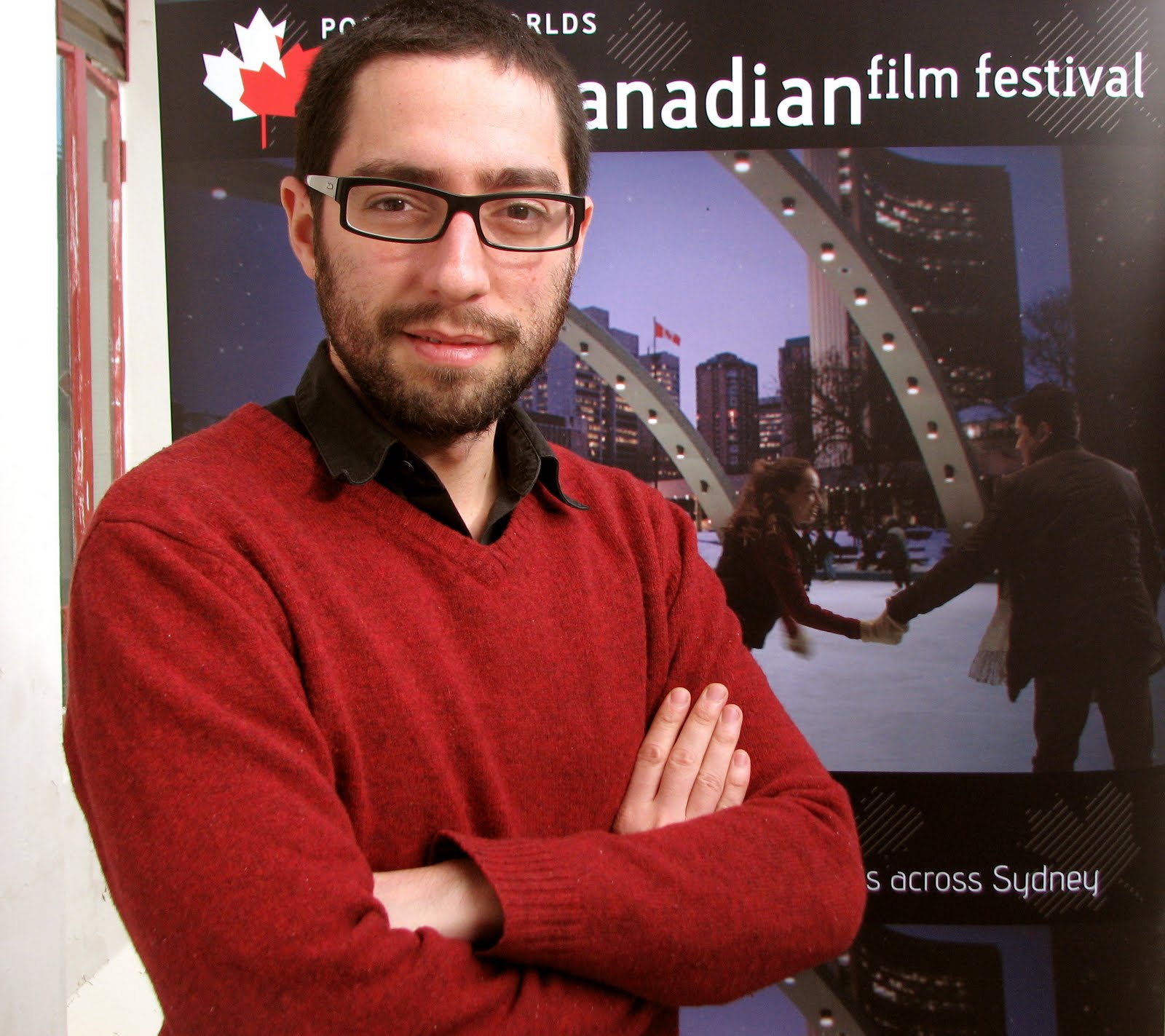
Possible Worlds- The Canadian Film Festival starts in Sydney on the 2nd August, for what will be its 5th year. Showcasing the diverse and exciting cinema of Canada the festival includes, features, shorts, documentaries and animations. Possible Worlds is the brainchild of Sydney based not-for-profit film festival organisation, The Festivalists, who also put on the Young at Heart and Access All Areas film festivals. On the 5th anniversary of the formation of The Festivalists (15th July) I caught up with one of its founders and its Artistic Director, Mathieu ‘Matt’ Ravier to discuss his passion for films, Canada cinema and Sydney’s Canadian Film Festival- Possible Worlds.

Matt’s interest in films was sparked at a young age, partially because of his limited access to them. His childhood bedtime meant that he only ever got to watch the first 20 minutes of films on television growing up- “this thing of having a curfew when I was younger and watching the first part of hundreds of films, really created this appetite because it felt like this forbidden thing that children didn’t have access to. You watch enough first half of movies- you just want to find out what happens to at least half of those”.

As a teenager Matt’s favourite pastime was going to the cinema, but it was a chance encounter with actor Harvey Keital, who was in Sydney promoting The Piano, that steered Matt towards a career in the industry. “Talking to Harvey Keital about his involvement with Tarantino, who was completely unknown at that time, producing Reservoir Dogs and acting in the film and just listening to him speak with such enthusiasm and passion… I think it was probably that day that I decided this is what I wanted to do- anyway possible, work in film. I had no idea back then what I wanted to do exactly within the film industry, but that was a key moment for sure.”

After school Matt returned to his native France to start a Business degree- “Both my parents are sort of lefty, ex-hippies and it was to get back at them. It was a rebellious move to go- look I’m going to become this really successful, really rich business man. Of course as soon as I started business school I realised I didn’t particularly enjoy it. But I did learn quite a lot of things that have been useful throughout the following years.” It was a last minute choice to study in Toronto that gave Matt his first exposure to the inner works of a film festival and Canadian Cinema- “I was really lucky to be able to do an MBA in Toronto, they have this amazing program there which is an MBA with a specialisation in Arts Admin. All your lecturers are Arts professionals and you get to learn a whole lot about how to run an Arts Organisation. As part of that I did an internship at the Toronto Gay and Lesbian film festival [Inside Out].” It was his experiences at Inside Out that propelled Matt into a career in film festivals. “That’s probably the year I thought wow, running a film festival is fun if you love films- because you get to watch a lot, you get to travel to film festivals, but it is also a cause in many ways. If you are working to showcase a cinema that is otherwise underrepresented then you are doing something beyond what say running a cinema entails- you are actually fighting for a cause. It is a cause I immediately recognised, it was something I believed in.”


The full interview can be read at Trespass

Wednesday, May 26, 2010

Women on Top- Interviews with Film Festival Directors

I have been lucky enough to work on a few film festivals in N.S.W over the last three years; I volunteered at the Sydney Film Festival (SFF) in 2008 and 2009, I have written for the Spanish Film Festival blog for the past two years and this year I have been working on the Dungog Film Festival. As well as getting to see how much time and effort goes into making these cinematic celebrations a success, I have also been inspired by the women who run them.

Clare Stewart of the Sydney Film Festival, Natalia Ortiz of the Spanish Film Festival and Allanah Zitserman spoke to me about their roles as Film Festival Directors, their passion for films, and the female experience in the Film Industry. This was especially generous as they all took time out during the run-up to their respective festival when they are at their most busy.


The most obvious question for all three women is, how do they define their role as a film festival director?

With the biggest festival to contend with, The Sydney Film Festival is now in its 57th year, Clare has been at the controls for four years,

“The role has many faces and is incredibly varied. I guess the critical part of my job really is the selection of the films for the festival and the overarching architecture of the guest filmmakers; choosing the guest filmmakers who will come to accompany those films.”

Both Natalia and Allanah founded their own festivals with the focus on the cinema closest to their own hearts, Spanish and Australian,

Running in five cities, The Spanish Film Festival comes to the end of its 13th year at the end of May. Natalia is hands on with every part of the festival,

“I reinvent the festival every year, by that I mean every year the program has completely different things to offer. I also work with the schools in promoting the films for kids. I supervise all the design of the website, the television commercials that we have, the program, the whole image of the festival. I also supervise the coordination of the print movement with the chairman. A bit of everything really”

The youngest of the festivals, The Dungog Film Festival runs over four days in May in the picturesque Hunter Valley region. This year is the 4th year of Allanah’s festival;

“I wear a lot of hats in this particular job. It is about developing a really dynamic and diverse festival that showcases the best of Australian screen content across the board. And really my focus has always been to create something that is about bringing Australian film and content to Australian audiences.”

How did these three hard-working ladies start their love affair with the cinema?

Clare, a country girl growing up in a small town, doesn’t quite have the childhood stories about films you might expect from such a passionate cinephile.

“You read all the wonderful tales about Martin Scorsese being taken off to see Red Shoes as a four year old by his mother, I have a very very scant number of stories to tell from my early childhood and teenage years. I can remember E.T. at the Leongatha drive-in, and Hanna Barbera productions’ Charlotte’s Web at Frankston when I was four or something. But really my passion for cinema came about because I lucked into taking on Media Studies as a course. I was majoring in cinema studies and film production. It was really there and the move to Melbourne and being surrounded by the opportunity to try all sorts of cinema I hadn’t known about before. Through things like the Melbourne Cinémathèque, and the Kino cinema had just opened at that time. It was a very exciting time for me then.”

In contrast Natalia’s induction to the world of films started from an early age in Spain, as part of a long-term family love affair with the cinema.


“My mother was a film critic at the national radio in Spain and used to do all the reviews and interviews for the San Sebastian International Film Festival. My father was more of a painter, but did the billboards, back in those days they were painted by hand. They both loved cinema, arthouse cinema- so I grew up watching Pasolini and Fellini combined with Disney films. It was really exciting, obviously everyone in my family loved cinema. For me it is like the air I breathe, I really need it, it is more than just like it, it’s a real need, I suck life from cinema.”

Allanah’s commitment to Australian cinema and Australian filmmakers comes from her drive to work hard and her belief in giving everything a go;

‘I came here as a refugee, when I was three, with my family. Everyday that I’ve been here, I have a sense within me about how lucky I am, that I ended up here, and how different my life would have been, had my mum not chosen to go to the country that is the furthest away from Russia. We came with one suitcase, we lived in housing commission properties, it was pretty tough for both my family and me. My parents instilled in me a very strong work ethic and a desire to be educated, that was something that was always in me. For me it wasn’t so much about what I was going to do, I didn’t know I was going to be in film, I just knew whatever I was going to do I was going to throw myself in 150%.”

Although these women have very different backgrounds, they all seem to have found the place that suits them best in their roles as festival directors.

Before becoming the Festival Director of the Sydney Film Festival, Clare was Head of Film Programs at ACMI (Australian Centre for Moving Images);


“I started volunteering at the Melbourne Cinémathèque and really got into programming as a sort of way to just feed myself if you like. I found out that was exactly the right place for me to be, because it combined the critical thinking I like to do about films with the role of actually taking that to an audience. Where I get my real buzz, is that great moment when the lights go down and you feel the audience engaging with a film that you’ve worked really hard to get onto that screen, and it is a very very rewarding moment. So it turns out that the perfect place for me was precisely in-between criticism and filmmaking.”

Natalia worked in the Spanish film industry as an editor for a number of years, before moving half way across the world;

“When I moved to Australia I realised the Spanish film industry was misrepresented on the screens here. You could only see Carlos Saura and Pedro Almodóvar, the usual suspects kind of thing. I thought there was more to it and because of my contacts and knowledge of the industry I could do something about it. I wasn’t really thinking about a film festival, I thought more about a film society and bringing a few films and doing Q&As etc… That grew to a national film festival with 45 films this year.”

Allanah movement into films began with a successful side project whilst studying business, starting up and promoting a club night called Barberella;


image

“It ignited something in me, and it became clear to me I had to do something creative that included the business side of me. I kept doing events. I knew I wasn’t going to work for a corporate company, I needed to do something else. I met Stavros and I worked with him on Strange Planet. I remember the first time that he brought me to set, to the production office and I walked in and I just had this moment where I just knew this is exactly what I wanted to do. It was creative, it was exciting, it was risk-taking and it tapped into my love of clothing, my love of music, my love of hard work, my love of the business side and story telling.”

In 2007 Allanah co-founded the Dungog Film Festival, the biggest festival of Australian content in the world, with her partner Stavros Kazantzidis (with whom she co-wrote and co-produced the AFI award-winning Russian Dolls) “People always find it quite amusing that it took a Russian and a Greek to put on the first Australian festival.”

This being women’s week, I had to ask these high-profile women, who are at the top of their field, were they concerned about the lack of women in key positions behind the camera in the film industry?

Clare made a point that I had found to be very true whilst researching,

“I certainly think you see a lot of women in producing roles, in bureaucracies, you see a lot of women now in the curatorial programming side of things. But I do think it still really is a struggle for women who are directing and are in certain technical roles as well. I’m not really sure why that is the case.”

And while Allanah is very positive about the Australian Film Industry; ‘in this country we’ve got a lot of really talented women filmmakers. I think Australia is quite progression in that regard.”

It is Natalia who is most passionate about the issue,

“I think probably when people are reading your article they will be like ‘ah here we go again’ but you know there are still people who don’t want to acknowledge there is an issue for women to be treated equally. You can see it in the film industry, I think it is about 8 or 9 % of films are directed by women, and 15% of important roles in the film industry are held by women; that is directing, writing or producing. Why is that, we are as creative as males. This year a women won an Oscar for the first time in history- why is that? This is something that we need to question obviously.”

Clare, Natalia and Allanah all thrive on the shared film experience, bringing their audience, original and dynamic programs. Each of their festivals showcase the amazing diversity in film today. Their programs all reflect the breadth of female filmmaking talent too. This year the Spanish Film Festival had a special section devoted to films from female directors, called
All By Women, (some recommendations of films to look out for during the SFF and Dungog Film Festival from Clare and Allanah are at the end of this piece).

I asked Clare, Natalia and Allanah to each give me a highlight or a stand out moment from their festival careers so far and I think each answer illustrations their dedication to film and their desire to put on the best possible events for their audiences.

Clare
“After the intense effort of establishing the official competition having Hunger take out the first official competition prize [in the inaugural year, 2008] was a really terrific moment. Being able to secure the second screening in the world of a film like Steve McQueen’s Hunger for that competitive program and then having such an extraordinary film go on and win, really set the agenda, set the benchmark. A festival director would want that to happen for a competition, which was about audacious, courageous and cutting edge films. That was definitely a very significant moment.”

Natalia “Just getting [the festival] up and running every year! Because every year there is a different story, the financial crisis, the swine flu- last year we couldn’t get any films coming out of Mexico, and we’d bought out a special Luis Buñuel retrospective. This year we had the volcanic ash in Europe. Every year the biggest achievement is to look back in June and say “we’ve done it”. It is a learning curve, when I look back at the first festival with four films over a weekend and where we are today- you can imagine ever single day is huge learning in every aspect of what you do.”

Allanah “I guess just having 500 people at the Saturday night party dancing together. From the ages of 18-85, all different backgrounds and social backgrounds, all mixing and mingling and having such a wonderful time together. Last year we had Three Blind Mice, on the Saturday night and we had a line going from the cinema right up to the train station to get into the film, and we ran out of seats, so we were throwing more seats in.”


The Spanish Film Festival has finished for this year in Sydney, Canberra and Adelaide, but is still underway in Brisbane, and due to ‘popular demand’ the festival has been extended in Melbourne- click here for details.

The Dungog Film Festival runs from 27th -30th May. For programming and ticketing information click here

The Sydney Film Festival runs from the 2nd-14th June. For programming and ticketing information click here

Here are some recommendations from Clare and Allanah of some of the best of female directed films on offer at their festivals;

The Sydney Film Festival- Clare


image

Miranda Otto in Shirey Barrett’s South Solitary

“I’m so excited this year about how many films we have in the program that are directed by women. I couldn’t be more delighted to be opening and closing the festival with films by Shirley Barrett and Lisa Cholodenko, two very intoxicating filmmakers who have great track records and whom we have been waiting for next films from for quite some time. You look at their films, you look at Debra Granik’s Winters’ Bone, the very wonderful, compelling, stark and riveting film that won the jury prize at Sundance this year. You look at Claire McCarthy the Sydneysider’s second feature The Waiting City, which has just come leaps and bounds since her first film which we loved very much and did the world premiere in my first festival Cost Life. As well as Julie Bertucelli’s film which is screening in official competition, a French Australian co- production called The Tree and Sophie Letourneur, a young, extraordinary French director who has made a film Chicks about a bunch of Parisan students in their early twenties, who all share this apartment called the Ranch, which is a very different kind of film again. Through to someone really classic, well classic in the sense that she is a contemporary master, Claire Denis and her wonderful film White Material. I think that there are a lot of really terrific films directed by women on offer in the festival this year”

Dungog Film Festival- Allanah


image

Lily Bell-Tindley and John Hurt in Belinda Chayko’s Lou

“This year’s program shows how many women are working in the industry- Belinda Chayko’s Lou is the opening night film Sue Brooks’ Subdivision is the festival’s closing night film. We also have the World Premiere of Surviving Georgia by Sandra Sciberras and Kate Whitbread. We’ve got Alexandra Schepisi’s amazing short film One Night. Also this year there are Master Classes with Gillian Armstrong and Nadia Tass, as well as a panel discussion called Women in Film, done in collaboration with iTunes’ Meet the Filmmaker Panel, which features Belinda Chayko, Gillian Armstrong and Alexandra Schepisi.”


Published as part of Trespass' Women's Week