Monday, November 15, 2010

Interview: Emily Calder / Flightfall

A mystery of creative collaborations

I speak to Emily Calder, Flightfall is a week from opening at the Old Fitzroy Theatre, and the young playwright can hardly believe it. “It is feeling very surreal at the moment. It’s been two years of lots and lots of re-drafting. In my mind I never really imagined it would be on.” For the 26-year-old NIDA graduate, it’s a significant milestone: her first produced full-length play. Covering topics of fidelity, passion and creativity,Flightfall has a young cast of talented up-and-coming Australian actors, and will be directed by Calder’s fellow NIDA graduate, Mark Grentell.

In fact, Grentell has been an instrumental to Flightfall from its inception.“Mark approached me at the end of my Playwrights Studio year at NIDA, and he wanted me to write about a particular subject,” Calder explains. “It was very broad in scope and I struggled to find the story I wanted to tell to represent that.” It was a bit of fortuitous timing that saw Calder’s first draft become part of Sydney Theatre Company’s Next Stage program. “Mark was working as an assistant director on a production here (STC) and he mentioned our project, and they had some workshops they were offering to writers.”

Calder credits Next Stage as an integral force in the play’s development “We had a really amazing three day workshop at the STC and we had three of the young female actors [from the STC’s Residents] basically doing lots of improvisations, and I wrote a whole lot of new scenes from it.” Calder is enthusiastic about the need for artistic collaborations throughout the whole writing process. “One of the sweetest words to my ear is ‘workshop’. You are sitting there all alone in your room, and you read the words out to yourself, but until you actually hear them coming from someone else… I’ve been so lucky to have fantastic actors reading for me, the whole way through.”

In Grentell’s production of Flightfall Augusta Miller (Happy Feet) plays Nina, an artist who is seduced by her new muse (played by Ryan Corr ofPacked to the Rafters), causing tension with her boyfriend Sam (James Elliot) and her best friend Jo (Alexandra Fisher). Although Calder will discuss the play’s themes and tone she is a little coy about the plot. “Flightfall is a bit of a mystery play, so I can’t give too much away… the play is about this artist and her story. It is about art, and what happens with her and her boyfriend, but it also represents poetically something else, which you find out about at the end.”

At a certain point, with the show cast, and its premiere season approaching, Calder had to let go of her baby. “Mark and I had discussed the need to give the director and the actors the script by themselves, and not have the pressure of the writer in the room. I kind of really missed being [in rehearsals], because I loved it so much, and I have to admit I did have that initial ‘oh my baby’ – which I think is typical to all writers.”

There’s always the ‘next thing’ to look forward to, however. “There has been so much work put into it, it would be wonderful if it had a run somewhere else, or got picked up for another venue,” Calder reflects. “I hope it will open doors so I can write more. I suppose everyone would just love to do it again, I think.”

First published in The Brag 25/10/2010

Image 1

Wednesday, November 10, 2010

The Social Network


With its themes of friendship, betrayal and ambition, The Social Networkis one of the best and most intriguing films of the year. The combination of wordsmith Aaron Sorkin (The West Wing) and director David Fincher (Fight Club) has produced something exciting and narratively creative. Using two co-running lawsuits against Facebook founder Mark Zuckerberg (Jesse Eisenberg) the film tells the origin story through disputing voices and ‘truths’.

We open with 19-year-old Harvard student Zuckerberg out on a very uncomfortable date with his girlfriend (Rooney Mara). Showing off Sorkin’s signature rapid-paced, witty dialogue, this scene perfectly highlights the irony of the world’s largest social networking tool being created by someone who is socially inept. The narrative cuts between boardroom legal negotiations: on the one hand, original investor Eduardo Saverin (Andrew Garfield) is suing Zuckerberg for squeezing him out of the company after its move to Silicon Valley; on the other, the Winklevoss Twins (played by Armie Hammer) and Divya Narendra (Max Minghella) are suing Zuckerberg for stealing their idea for Facebook. Using this legal setting to weave in and out of events and perspectives, Fincher’s directing is as intelligent as Sorkin’s words.

The young, up-and-coming cast is impressive. Eisenberg brings both arrogance and vulnerability to the role of the computer genius who wants to get noticed. Garfield’s performance, equally good, is a jovial counterweight to Eisenberg’s deadpan. Proving his chops as an actor, Justin Timberlake is the film’s only true villain, playing Napster co-founder Sean Parker, who seduces Zuckerberg with his rockstar charisma.

Certainly part of the film’s appeal is simple curiosity, about one of our generation’s most defining entrepreneurs; but with superb storytelling this film also seems to be saying something more about our lives right now and the rise of the tech-savvy.

4.5/5

First published in The Brag 1/11/10

Images 1,2

Tuesday, November 2, 2010

Made In Dagenham

Based on the true events Made in Dagenham explores womens’ struggle against sexual discrimination in 60s-era England. Brits do social commentary films very well. Kitchen sink dramas are staples of their film industry- with often bleak, harrowing films about Britain’s working class. So it is a pleasant surprise that director Nigel Cole hasn’t taken this story of factory strikes and union movements down this gritty route and has instead given us a fun, up-beat dramedy.

When the female machinists at American car giant Ford’s UK manufacturing plants are reclassified as unskilled labour and are moved to a lower pay salary, the employees at the factory in Dagenham, a borough in Greater London, move for industrial action. Lead by shy, but passionate worker Rita O’Grady (
Sally Hawkins) the women stage the first ever female strike, scaring both Ford and the Unions. What follows is a stalemate which raises issues of gender and rights forcing the British Government to take notice.

The competition between domestic duties and principles pull the women in differing directions giving some shade to the film’s overall light atmosphere. While
Made in Dagenham’s message is loud and clear, the script’s witty dialogue and the cast’s performances stop it from being belligerent, or overly self-righteous.

Hawkins is fantastic as Rita, a woman who finds her voice fighting for sexual equality. There is a delightful cheekiness as well as stern determination to the character, which makes her a charming lead. Also brilliant is
Miranda Richardson as Secretary for State Barbara Castle, whose role shows off another side to women in the workforce.

The film does overload the 60s clichés. Fashion and make-up are emphasised to the point that they are less setting and more proof that we are in the 60s- indeed we must be because there are hot-pants and massive beehives everywhere. But this is a small problem in what is overall a heart-warming and delightful film. The spirit of standing up and being counted is an important message that Made In Dagenham spreads by being entertaining rather than moralising.

3.5/5


First published in The Brag 25/10/2010

Images 1,2

Saturday, October 30, 2010

Most Terrifying TV/Film Characters

It is Horror Week over at Trespass, so I a sked contributors to pick the 3 most terrifying characters from either film or TV. Here are my picks...

Bob (Frank Silva) from Twin Peaks (1990-1991) and Fire Walk with Me (1992)

Bob is undoubtedly one of the most disturbing TV characters of all time. A demonic entity, Bob gains strength and pleasure from the fear and suffering of his victims. With the ability to possess humans who do his bidding, Bob’s character represented both the abstract notion of pure evil and also the idea of the evil within the human character. Bob’s status as a terrifying character is not only credit to the surreal visuals of the show’s creators- David Lynch and Mark Frost but also linked to the ambiguity of the character, was he real or imaginary- the catalyst for violence or the excuse?


Pennywise the Dancing Clown
(Tim Curry) from It (1990)

The TV miniseries It can be blamed for many a person’s fear of clowns. Adapted from Stephen King’s horror novel, the title refers to a creature that can take on many different forms, often using its victims’ worst fears and phobias to hunt and kill them. With a taste for children, It most often appears as Pennywise, a playfully sadistic dancing clown, who attack his victims with fang-like teeth and claws. Watching It at a young age, the character of Pennywise has stayed in my psyche, and I often find myself irrationally crossing the road when I came to a drain.

Norman Bates (Anthony Perkins) from Psycho (1960)

I can’t count the numbers of time I’ve been spooked by a ‘movement’ behind the shower curtain. Perhaps I’m just a nervous bather, or maybe it is the indelible mark of Hitchcock’s horror classicPsycho and its infamous murderer- Norman Bates that is the cause. A man with some seriously scary mother issues, Bates is all the more terrifying because he doesn’t look like a monster, in fact he looks like your average Joe.


You can read the full list at Trespass


Images 1,2,3

Thursday, October 28, 2010

The Town

Following his critically acclaimed directorial debut, Ben Affleck’s (Gone Baby Gone) sophomore feature sees him returning to his beloved Boston, and its criminal underbelly. Adapted from the novel Prince of Thieves by Chuck Hogan, The Town follows a gang of bank robbers who all hail from Charlestown, Boston- an area with more armed robbers per square mile than anywhere else in the world (a fact with which the film opens).

Not content with directing credits alone Affleck heads up the cast as Doug MacRay, a criminal with a heart and a brain. MacRay is part of a tight-knit group of bank robbers including the slightly unhinged Jem (Jeremy Renner, The Hurt Locker), ‘Gloansy’ the driver (Slaine, Gone Baby Gone) and (because you can’t have odd numbers of criminals) Desmond (Owen Burke). The gang holds up a bank, taking the manager Claire (Rebecca Hall, Please Give) hostage. After releasing Claire they discover she lives in their neighbourhood and could potentially finger them to the FBI.

While Jeremy Renner steals every scene he is in, other actors feel painfully out of place. Mad Man’s Jon Hamm overacts the role of Agent Frawley, the FBI man who will do anything to catch his target. Also falling into clichéd territory is Pete Postlethwaite (Usual Suspects) as the sociopathic florist Colm Fergus. Blake Lively (Gossip Girl) as Krista, Macray’s sometimes bed partner, seems terribly miscast. The actress is too pretty and too young (or perhaps Affleck is too old) for her backstory.

The Town is the classic one-last-job heist film. High adrenaline action sequences and the odd witty one-liner lift this film above what is essential a very average crime flick. While elements of the casting are questionable, aside from one poor performance, the actors do the best with what they were given. Unfortunately this story is not strong enough to handle the pathos being piled on it. Entertaining with enough intrigue to keep audiences’ attention, The Town is a good film despite its faults. Perhaps the film is most hampered by high expectations, which neither the plot, the cast nor the director could quite live up to.

3/5

First published in The Brag 18/10/2010

Images 1,2

Thursday, October 21, 2010

The White Ribbon DVD review

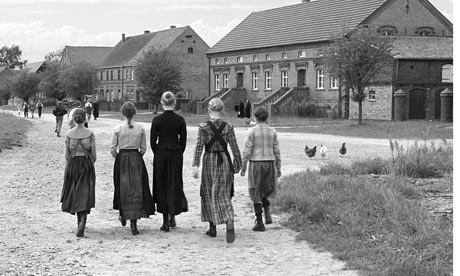
Winning awards for director Michael Haneke and cinematographer Christian Berger (including the Golden Palm at Cannes) The White Ribbon has been one of the most internationally acclaimed films of the past year; and it is not hard to see why. This exquisitely shot exploration of ideology is unnerving and uncomfortable viewing, but it is also completely intriguing and utterly intelligent storytelling.

Set in a small northern German village in the years preceding the outbreak of WWI, the story of a series of strange incidences, escalating in violence and malice is narrated by the village’s schoolteacher (Christian Freidel, voiced in narration by Ernest Jacobi). Growing tension between the farmers and the village’s primary landowner- the Baron (Ulrich Tukur), and the oppressive authoritarian practices of the village’s parents, particularly the pastor’s (Burghart Klaussner) use of ritual to punish his own children- offer clues as the to the perpetrators of the crimes and their motivations. But The White Ribbon is not a film with resolutions, and Haneke’s story is filled with undercurrents of the horrors that are to follow in Germany, with WWI and WWII.

With an excellent cast of children, who range from the very sweet to down-right creepy, the film’s repressive atmosphere requires understated performances. Maria-Victoria Dragus and Leonard Proxauf are superb as the Pastor’s two eldest children bringing a powerful sense of intense stillness and internal rage. Along with the disturbing elements of the film, there is also a very gentle and lovely romance between the schoolteacher and the nanny at the Baron’s estate, Eva (Leonie Benesch), which makes a welcome contrast to the film’s sombre tones.

4/5


First published in The Brag 11/10/10

Images 1,2

Monday, October 18, 2010

Let Me In

Let Me In is the American remake of the 2008 Swedish arthouse hit, Let the right One In, adapted from John Ajvide Lindqvist’s novel. This horror/coming of age vampire story focuses on the friendship between bullied 12-year-old, Owen (Kodi Smit-McPhee) and his vampire neighbour, eternally 12-year-old Abby (Chloe Moretz). Coming so soon after the acclaimed foreign language original, is this an unnecessary remake?

While the original is a superior film, Matt Reeve’s (Cloverfield) remake is not without its charms. Wisely the American director has stuck close to the source material, with the snowy landscapes of a small New Mexico town standing in for the wintry Swedish countryside. Like its predecessor, Let Me In defies genre- avoiding the gothic romance and mythology of most vampire stories. Although there are scenes of violence, they are just as frequent in Owen’s world of school bullies as Abby’s world of blood thirst.

Let Me In’s ability to stand as a film in its own right is boosted by excellent performances from the two young actors who navigate the film’s dangerous world of prepubescence. Australian actor Smit-McPhee (The Road) perfectly transmits Owen’s sense of isolation and Kick-Ass star Moretz further proves her impressive acting chops. The film is buoyed by a fantastic supporting cast including Richard Jenkins (The Visitor) as Abby’s father/familiar and supreme character actor Elias Koteas (The Killer Inside Me) as the police inspector.

There is a certain heavy-handed sentimentality to Reeve’s film, which affects the film both positively and negatively. The closeness of Owen and Abby’s relationship is textured by the film’s sweeter moments, but the soundtrack is completely over-the-top and distracting. Surprisingly the film’s special effects are poor, Abby’s vampiric transformations jar with the surrounding action. However Australian DoP Greig Fraser (Bright Star) has done another incredible job with beautiful and exciting visuals, particularly some exceptionally shot car sequences.

Reeve can’t claim any originality with this film, but that shouldn’t take away from what has been accomplished. Respecting the nuances of the book and the first version, he has delivered a good film that will bring a wider audience to this superbly dark tale.

3.5/5


First Published in
The Brag (11/10/2010)

Images 1,2,3