Showing posts with label British Cinema. Show all posts

Friday, February 25, 2011

Down Terrace

Down Terrace is a low budget British crime film from first-time director, Ben Wheatley. Set in the coastal city of Brighton, the film follows a criminal family, headed by patriarch and ex-hippie Bill (Robert Hill) who runs clubs and drugs for his bosses in London. His henchmen include his troubled son Karl (Robin Hill), his brother-in-law Eric (David Schaal, The Office and The In-Betweeners) and the hapless Garvey (Tony Way). The film begins with father and son leaving court after being cleared, of exactly what charges we are never told, and returning to their small terrace home where seemingly devoted mother and wife Maggie (Julia Deakin, Spaced) is waiting. However all is not well with this criminal unit. There is an informant in their midst. Betrayal and murder sees the family implode as the offender is sought out.

Wheatley co-wrote the script with Robin Hill. They have been writing and shooting shorts together for a number of years, often filming at Robin’s parent’s house on Down Terrace and starring his father, Robert. The writing pair decided they wanted to shoot a full-length film. As it needed to be something they could make on a small budget it had to feature Robert and Robin and be able to be filmed at the house on Down Terrace. And that’s how the idea for the film began.

Karl (Robin Hill)

The end result is a gangster film, but unlike anything you’ve come to expect. This is a film completely devoid of the glamour that often accompanies movies about professional criminals. Taking elements of the crime genre the film’s real focus is on the corrosive nature of a dysfunctional family. This darkly comical piece is populated by characters whose danger derives from how emotionally-stunted they are. Karl, a man in his thirties, lives like an overgrown teenager in his parent’s home, smothered by manipulative parents. Maggie is perhaps the most disturbed (giving Jackie Weaver’s matriarch in Animal Kingdom a good run for her money), as she at first appears to be a reasonably caring mother and wife, but when her true nature is revealed she is terrifying.

Down Terrace is a great example of clever filmmaking working within tight parameters but creating something exciting and fresh. The script highlights the productions natural strengths, the strong bond between real-life father and son Robert and Robin; the limited locations help exaggerate the claustrophobic and paranoid nature of the crumbling family.

Maggie (Julia Deakin) and Bill (Robert Hill)

Down Terrace is a surprising film, fitting in more to the kitchen sink drama mould of British filmmaking than the thumping soundtrack and bravado of Guy Richie’s criminal visions. No doubt this is an off-kilter gangster film, but somehow the occasionally shocking violence and the comedic elements combine to make something charmingly original.

Images provided by Madman

First Published on Trespass

Thursday, February 24, 2011

Another Year

British director Mike Leigh is known for making kitchen sink dramas and over the years has had great critical success with Secrets & Lies (1996), Vera Drake (2004) and Happy-Go-Lucky (2008). Known for his improvisational style of filmmaking, Leigh rehearses with a group of actors (usually long-time collaborators) over a number of months creating story from his outlined scripts, before filming begins. Not one to shy away from tackling tough themes, Leigh’s work tends to approach topics with subtlety and restraint, never taking the drama over-the-top or to melodramatic extremes. But it is in this gentle teasing of theme that Leigh makes his best observations about life, and Another Year is a fantastic example of the director working at his best.

Gerri (Ruth Sheen) and Tom (Jim Broadbent)

Following a middle-aged couple Tom (Jim Broadbent) and Gerri (Ruth Sheen) over four seasons, the film looks at their relationship with friends, colleagues and family. A birth, a death and a new love are all events in the film, but this slow-paced character study is really about happiness and loneliness. The film’s gentleness is deceptive as it draws you into the seemingly mundane lives of the characters. Another Year is divided between the happy; Tom, Gerri and their adult son Joe (Oliver Maltman) and the sad; Gerri’s work colleague, Mary (Lesley Manville), Tom’s friend Ken (Peter Wight) and Tom’s brother Ronnie (David Bradley).

Joe (Oliver Maltman), Mary (Lesley Manville) and Gerri (Ruth Sheen)

Leigh’s film, Happy-Go-Lucky explored similar themes and Poppy (Sally Hawkins) the eternally optimistic central character in that film was dismissed by some viewers as being annoyingly happy. Watching Another Year the same charge could be laid at the feet of the film’s happy characters, and there are moments when their cheerfulness feels smug. But then you have to wonder what that says about you, the viewer, that you find genuinely contented characters grating. It is this mirror that the film holds up to its audience which makes it so clever. Watching the film and its characters’ outlook on life it is impossible not to meditate on your own. Mary’s (Manville) disappointments over the year are increasingly devastating, but at the same time you find yourself desperately hoping that you aren’t also one of life’s losers.

Ken (Peter Wight) and Mary (Lesley Manville)

While the ensemble cast are all impressive, Manville stands out and it is unsurprising that she has been nominated for a best supporting actress BAFTA. She allows Mary to be a character you are both sympathetic towards, but also infuriated by.

Another Year is definitely one of Leigh’s best films, with the apparently ordinary proving to be quietly and subtlety moving.

Images 1,2,3

First published on Trespass

Monday, December 13, 2010

Monsters


The independently-made sci-fi films that have been popping up over the last two years have more than proved that smaller films in this genre can compete, and in some cases completely outclass, the studio-funded big guns. Monsters is one such example, beautifully crafted from a tiny budget (reported to be anything from $15,000 to $500,000), with a miniscule cast (two professional actors) and a crew of four, including creator, director and cinematographer Gareth Edwards (making his feature film debut).

A road movie, a love story and a travelogue, Monsters is not much like a sci-fi film at all. Taking a unique spin on alien invasion, the film’s premise has similarities to District 9, with alien life forms taking up residence on Earth, in an area that is economically deprived. But here is where the comparison ends; Monsters treads a very different path, creating an engaging and poetically humanistic film.

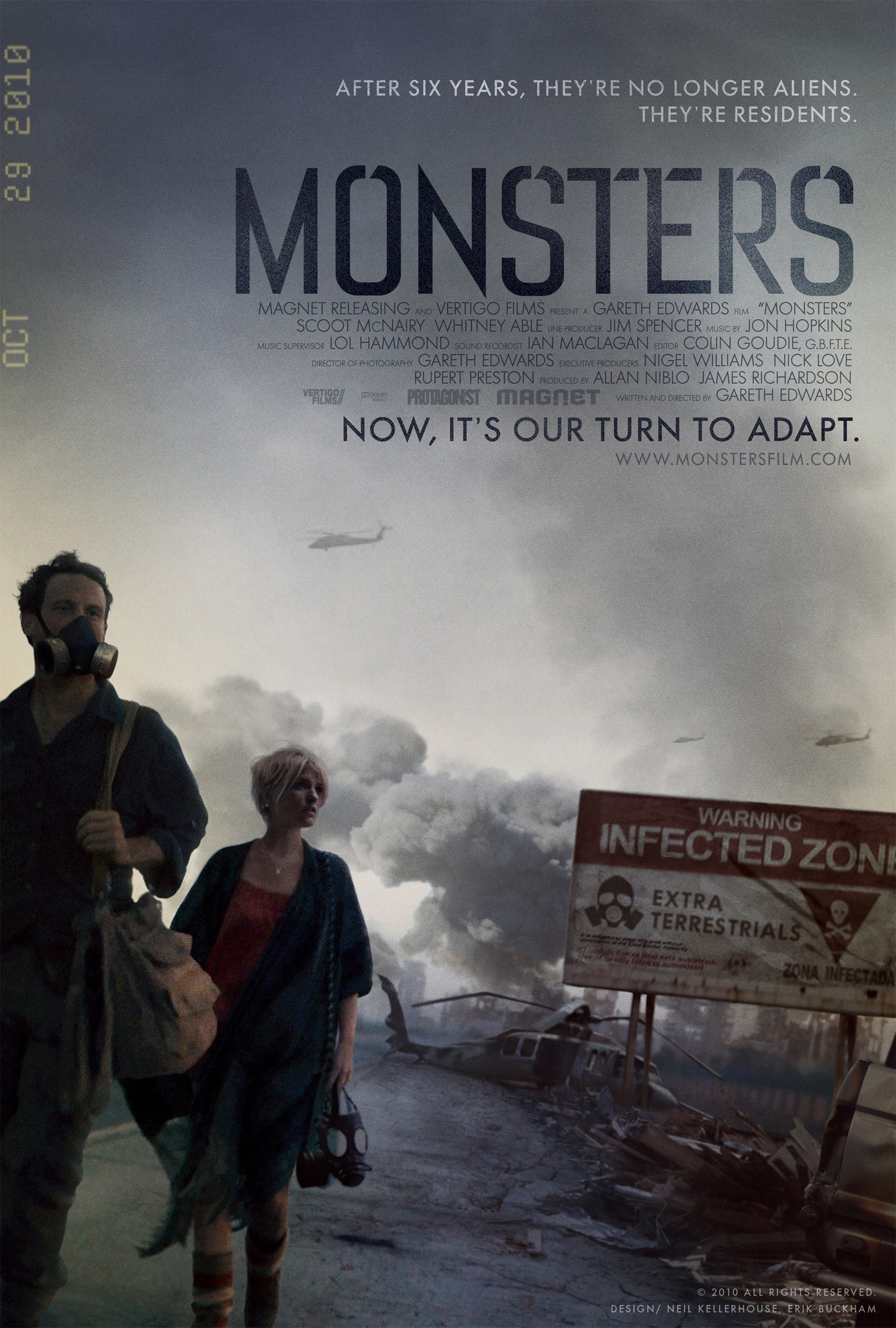
The story takes place in the ‘Infected Zone’ of northern Mexico, as an unlikely pair of travellers try to make their way northwards – and homewards – to the United States: photojournalist Andrew Kaulder (Scoot McNairy) and his boss’s daughter, Sam (Whitney Able), who he has reluctantly agreed to escort. The film’s success owes a huge amount to the chemistry between its two leads, a couple in real life. While this is an obvious advantage, the quality of their performances shouldn’t be underestimated.

Monsters is a good-looking film, with Edwards creating a lovely visual lyricism from Central American landscapes. As the person behind the special effects he has also created magic in post-production, providing the all-important extra-terrestrial action.

With clever political undertones, an affecting love story and gigantic squid-like aliens, Monsters may just be the best sci-fi film of 2010.

4/5

First published in The Brag 30/11/2010

Image 1

Tuesday, November 2, 2010

Made In Dagenham

Based on the true events Made in Dagenham explores womens’ struggle against sexual discrimination in 60s-era England. Brits do social commentary films very well. Kitchen sink dramas are staples of their film industry- with often bleak, harrowing films about Britain’s working class. So it is a pleasant surprise that director Nigel Cole hasn’t taken this story of factory strikes and union movements down this gritty route and has instead given us a fun, up-beat dramedy.

When the female machinists at American car giant Ford’s UK manufacturing plants are reclassified as unskilled labour and are moved to a lower pay salary, the employees at the factory in Dagenham, a borough in Greater London, move for industrial action. Lead by shy, but passionate worker Rita O’Grady (
Sally Hawkins) the women stage the first ever female strike, scaring both Ford and the Unions. What follows is a stalemate which raises issues of gender and rights forcing the British Government to take notice.

The competition between domestic duties and principles pull the women in differing directions giving some shade to the film’s overall light atmosphere. While
Made in Dagenham’s message is loud and clear, the script’s witty dialogue and the cast’s performances stop it from being belligerent, or overly self-righteous.

Hawkins is fantastic as Rita, a woman who finds her voice fighting for sexual equality. There is a delightful cheekiness as well as stern determination to the character, which makes her a charming lead. Also brilliant is
Miranda Richardson as Secretary for State Barbara Castle, whose role shows off another side to women in the workforce.

The film does overload the 60s clichés. Fashion and make-up are emphasised to the point that they are less setting and more proof that we are in the 60s- indeed we must be because there are hot-pants and massive beehives everywhere. But this is a small problem in what is overall a heart-warming and delightful film. The spirit of standing up and being counted is an important message that Made In Dagenham spreads by being entertaining rather than moralising.

3.5/5


First published in The Brag 25/10/2010

Images 1,2

Saturday, August 28, 2010

Four Lions


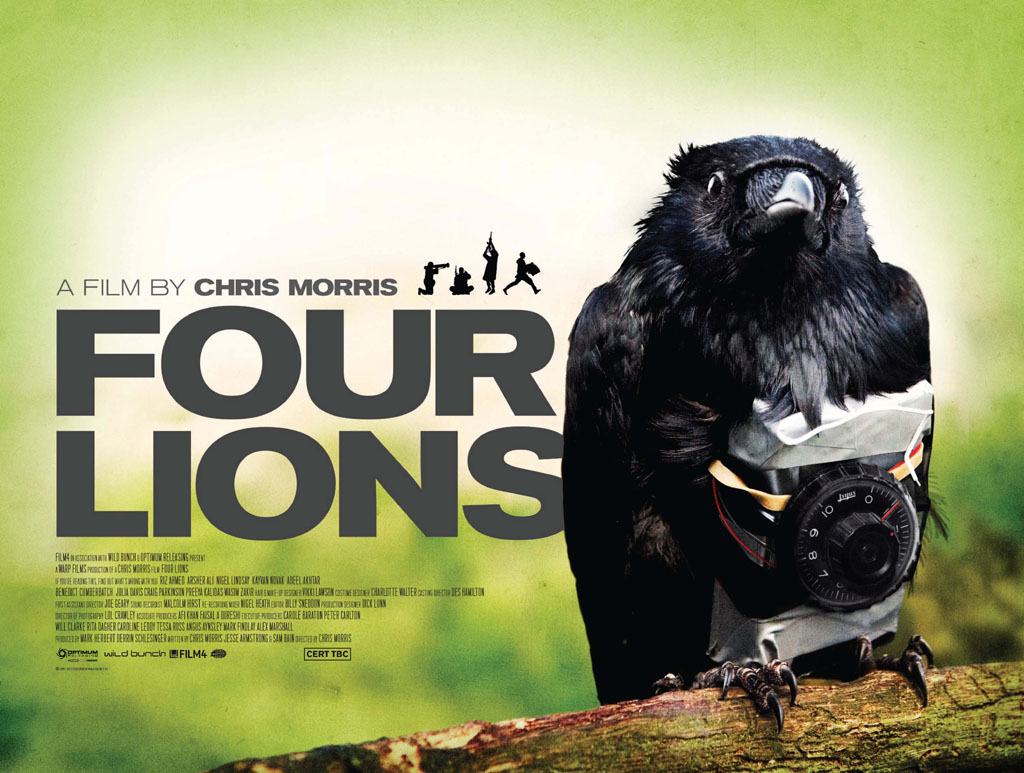
Chris Morris’ tv shows in Britain have caused outrage, controversy and hours of amusement. Whilst his ‘edgy’ humour isn’t to everyone’s taste, his scathing appraisals of the media, hipsters and celebrities has borne fruit in cult hits like Brass Eye and Nathan Barley. Now turning his hand to filmmaking, Morris has chosen a topic which seems completely inappropriate for comedy- terrorism. Four Lions follows the fortunes of a small group of British jihadists as they attempt to come up with a way to strike a blow against a country they feel alienated from. In the same way that This is Spinal Tap looked at heavy metal music, and In the Loop looked at transatlantic politics, Four Lions is a farce looking at the modern idea of terrorism.

Morris spent three years researching the topic speaking to terrorism experts, police, secret services, imans and members of the British Muslim community. What he found was there were plenty of comedy elements that already existed in the situation- like a terrorist cell that accidently overloaded their boat with explosives, so it sunk before reaching its US warship target or a terrorist mastermind who spend hours looking for a costume that wouldn’t make him look fat in his martyrdom video. A jihadist cell- like any other grouping of people- is full of misunderstandings, petty rivalries and bravado. Morris sums it up pretty succinctly-“Terrorism is about ideology, but it’s also about berks.”

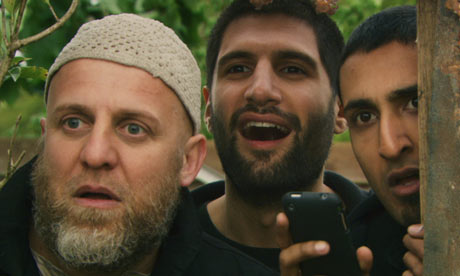
Four Lions’ jihadist cell consists of: Omar (Riz Ahmed, Centurion), the unofficial leader of the group, who has an uncle in Pakistan with links to training camps; Waj (Kayvan Novak, The Fonejacker) who doesn’t have much going on upstairs, relying on Omar to do all his thinking; Barry (Nigel Lindsay), a white Islamic convert who is overly public about his views and really wants to be leading the cell; Faisal (Adeel Akhtar, Traitor) a quiet, sad man who worries about blowing himself up because then who’ll look after his sick dad. This group struggles to come up with a plan of attack they can all agree upon, with the ever antagonist Barry unilaterally recruits another member, Hassan (Arsher Ali) a university student/wannabe political rapper.


There are times when the humour in Four Lion slips into silliness, but for the majority of the film it is sharp thanks to the scriptwriting of Sam Bain and Jesse Armstrong (Peep Show). At times it almost feels like you are being deceived by the comedy and wonder if you should be laughing at what you are seeing. This is the clever thing about this film- as it progresses you actually feel quite sorry for the men at the centre of the film. They are hopelessly inept and are confused about their grievances. Omar’s family scenes are particularly depressing- he explains jihadism to his young son using Disney’s Lion King as an analogy. Morris doesn’t allow his characters to escape responsibility just because the film is framed as a comedy, nor has he made his characters simply idiotic and sat back and poked fun at them, his purpose is to show how the whole situations has become a farce.

Four Lions is a film you expect to be funny given the comedic talent attached, but surprisingly it is also strangely moving as well.

Images 1,2

First published on Trespass

Thursday, June 17, 2010

Sydney Film Festival- The Disappearance of Alice Creed

image

It is quite frankly nice to see Gemma Arterton (Clash of the Titans, Prince of Persia) not in a mythical-themed film. This stunning British actress has for the past few parts played little more than a prop for her leading men, with her obvious talent going to waste. In this British thriller, Arterton, as the title character Alice, is one of only three actors on screen, with her cast-mates Eddie Marsan (Happy-Go-Lucky) as Vic and Martin Compston (Red Road) as Danny, her two kidnappers. This film shows not only how good Arterton truly is, but also how much can be done with a small budget, committed actors and an excellent script.

The Disappearance of Alice Creed is tense and enthralling viewing. Set almost entirely in a flat with three rooms, writer/director J Blakeson plays a clever psychological game with his audience, utilising a basic crime premise. Rich girl, Alice is kidnapped and is held for a two million pound ransom by two ex-cons, who have meticulously planned the crime. But as with all of the best laid plans, in practice everything starts to slowly unravel, as the characters’ motivations become increasingly convoluted and entangled.

The fact that as a viewer you are unable to leave the flat, much like Alice, lends suspense to the film as you ponder what is happening outside. This heightened level of claustrophobia is intensified by the menace exuded by Vic and the jittery energy of Danny. Each actor gives as good as they get in this brutal, shocking and at times darkly funny film.

If you get the chance to watch The Disappearance of Alice Creed, which is J Blakeson feature debut, take it- you won’t be disappointed.


First published on The Brag 07/06/10

Friday, May 28, 2010

Fish Tank

image

British film, Fish Tank, the sophomore feature film from director Andrea Arnold (Red Road), was originally scheduled to be released in Australia in March, but distributors were forced to move the films theatrical release to May 27th. For once this serious rescheduling is a positive sign. When Fish Tank won Outstanding British Film at the BAFTAS in February this year, the film’s season in British cinemas was extended and expanded, so there simply weren’t enough prints of the film to be sent to Australia.

It is always good to hear that a small budget film has been given an opportunity to reach a wider audience, and even though it has meant a delay for Australian audiences, most will agree this incredible film was worth the wait.

Set in and around an Essex Estate in South England, this film focuses on 15 year old Mia (newcomer, Katie Jarvis) and the impact her mum’s new relationship has on her. Set in the same sort of council estates as shown in the recently released
Harry Brown, instead of stereotyping the lippy and troublesome Mia as a juvenile delinquent with homicidal tendencies- the marching-song propaganda of British tabloids, Arnold shows how vulnerable the seemingly bolshy and aggressive teenagers who live in these housing project truly are.

Living with her single mum, Joanne (Kierston Wareing) and younger, more sociable sister, Tyler (a fabulous performance from newcomer, Rebecca Griffiths), Mia has been excluded from school and spends her days wandering the estate, drinking cheap booze and practicing her dance routines. Both quick-witted and quick-tempered, Mia isn’t a pleasant teenager, but then she doesn’t seem to have any adults that particularly care how she is or what she does, that is until Connor (Michael Fassbender, 300, Inglourious Basterds) turns up.

Connor, Joanne’s new boyfriend, brings a whole new dynamic into Mia’s life, he not only notices her, but he also seems interested in her, what she thinks and what she does. Connor is like no-one Mia has met before, he has a steady job and a car and he like to get out of the city into the countryside.

image

Arnold’s film, beautifully shot by cinematographer Robbie Ryan (Red Road, Brick Lane) is meant to be a piece of stark social realism. The tangled and increasingly complex relationship that develops between Mia and Connor is both disturbing and devastating, with a certain amount of sympathy allowed to both characters.

Mia is a unique character on film and Jarvis brings strength and fragility to her performance. While she has an excellent supporting cast, this film’s success is predominately on the back of Jarvis, who had never acted before. So the story goes Jarvis was spotted on a train station platform in Essex, by a casting agent for Arnold. Jarvis caught the agent’s eye because she was having a heated argument with her boyfriend at the time. A little bit of fate, maybe, but the end result is an amazingly powerful and immersing film. Not finely polished like a big budget film, Fish Tank’s ability to connect with audiences is reflected in the multiple awards the film, its director and its star have received.

First Published on Trespass

Sunday, May 23, 2010

Harry Brown

image

There is a question which haunts you after watching Harry Brown; why do these filmmakers hate young people so much? This is a film which perpetuates a vision of British, working-class youth as hooded criminals who would stab/shoot you as soon as look at you. This is tabloid propaganda and an irresponsibly negative stereotype to attach to the youngest and poorest section of society. Harry Brown shame on you!

The film is a reworking of similar revenge movies. Labelled by its own marketing as the British Gran Torino, Harry Brown has much more in common with Charles Bronson’s Death Wish series, which was also an orgy of violence and unnecessary stereotypes. Harry Brown played by Michael Caine, is an ex-marine living out his retirement in one of England’s countless estates. He spends his days visiting his hospitalised wife and playing chess with his best friend Leonard (David Bradley, Harry Potter series) in a local pub. Brown keeps his head down, avoiding or ignoring the crime on his housing estate.

That is until Leonard is murdered and Brown, seeing the inadequacies of the police investigation, decides to hunt down the killers, vigilante style. Brown uses knives, guns and torture against a bunch of teenagers and junkies in a glorification of violence that is repugnant to watch. The suggestion that the audience should cheer on Brown’s bloody quest is truly alarming.

image

Harry Brown’s message is not the films only failing. As well as clearly signposting every single plot point, the film is also a waste of acting talent. Poor Emily Mortimer (Lars and the Real Girl) as D.I. Alice Frampton, the cop who wants justice and is suspicious of Brown, is so underwritten she is apparently only in the film as the token female. Sean Harris (who is amazingly good in The Red Riding Trilogy) obviously has fun as the menacing drug dealer, Stretch, doing a great impression of malevolent evil. The film wastes none of its 103 mins on character development for any roles aside from Caine’s, with the cast largely being there as fodder for Brown to kill.

image

Old people are scared of today’s youth. This is nothing new. Older generations have feared and disapproved of teenage behaviour for decades. The filmmakers have tuned into this paranoia and have tried to make it into a modern, contemporary problem. In actuality the imagined is far worse than the reality. Saddest of all is that Harry Brown’s filmmakers are perpetuating this negative message


First published on Trespass