Wednesday, January 5, 2011

Somewhere

Filmmaker Sofia Coppola is exceedingly accomplished in creating mood. Mixing a languid plot pace with very pretty visuals and chilled out soundtracks, her films, like the Virgin Suicides and Lost in Translation, are as much about generating an atmosphere as telling a story.

Coppola’s fourth film Somewhere is no different. Filmed on location at the legendary Hollywood hotel Chateau Marmont (situated on Sunset Boulevard) with a music score from frequent collaborators, French band Phoenix, Somewhere is set in the world of films and fame, but is very much focused on the reality of this seemingly glitzy existence. Stephen Dorff (Blade) stars as Johnny Marco, an actor numbed by drugs, booze and women. Marco is between projects, when his 11-year-old daughter, Cleo (Elle Fanning) turns up to stay, somewhat unexpectedly, causing him to re-examine his life.

Somewhere is nowhere near as moralistic as the synopsis sounds. Coppola who wrote the screenplay is familiar with this world, the daughter of a famous director (Francis Ford Coppola) the film’s scenes of press conferences and award ceremonies seem awkward enough to be realistic. Add to this Dorff’s backstory as an actor- slipping from a promising early career to B-grade fare- and this film has a fascinating meta-fiction quality.

Dorff, proving he deserves to be in more films like this, provides an excellent emotional centre to the film, allowing you to care about a character who should be highly unpleasant. The father/daughter dynamic in the film doesn’t feel forced, Fanning is a natural in front of the camera, providing a perfect counterweight to Dorff’s more introspective performance. Chris Pontius, who is best known for his role in Jackass, cheekily improvises his way through the role of Sammy, Marco’s friend, and is kind of great.

Somewhere’s slow pace isn’t going to be to everyone’s taste or attention spans, but if you allow this film to cast its spell over you, you’ll still be basking in the afterglow as you leave the cinema. Thoughtful, poetic and evocative, it isn’t hard to see why Somewhere won the Golden Lion at this year’s Venice International Film Festival.

4/5

First Published in The Brag 20/12/2010

Images 1,2

Love and Other Drugs

Reuniting Brokeback Mountain actors Jake Gyllenhaal and Anne Hathaway on screen should be a cause for celebration; unfortunately, this woefully trite and boring film has sullied the occasion. Ostensibly based on Jamie Reidy’s nonfiction book Hard Sell: The Evolution of a Viagra Salesman, this film is an adaptation in the very loosest sense of the word, with the screenwriters (director Edward Zwick, Charles Randolph and Marshall Herskovitz) turning the rise of big pharma companies into a romantic comedy.

Jamie Randall (Gyllenhaal) is a loveable rogue; good with ladies but bad at keeping a job. The underachiever in his family, he is convinced by his brother (Josh Gad) to take a position at Pfizer as a sales rep. Jamie is sent to Ohio where he must convince doctors to prescribe the depression drug Zoloft over Prozac. Jamie’s life takes a turn when he meets free spirit and Parkinson’s sufferer Maggie (Hathaway).

Set in the 90s around the time that Viagra was released on the market by Pfizer, Love and Other Drugs misses the mark on many counts. The filmmakers apparently deemed the real story of an overpaid, slacker drug rep in over-prescribed America as either too boring or too hard a sell. Instead, they (rather cynically) inject the Maggie character into the plot, hijacking a story worth telling and turning it into an unoriginal romance.
Gyllenhaal and Hathaway will leave this film unscathed because the likeable stars do a good job with what they have been given. The film basically asks them to be an attractive couple, which is what they do.Oliver Platt as Jamie’s mentor and Hank Azaria as a womanising doctor are shamefully underutilised in the film. In contrast Gad (who seems to have been hired as a Jonah Hill impersonator) is painfully overused as Jamie’s grotesque younger brother.

Lacking the sardonic wit or necessary bite to pull off a rom-com based in the world of pharmaceuticals, Love and Other Drugs is a very disappointing pill to swallow.

1.5/5

First Published in The Brag 13/12/2010

Images 1,2

Talking Genre Politics with Patrick Hughes

Red Hill marks Australian filmmaker Patrick Hughes feature film directorial and writing debut. Red Hill, a modern Australian Western, had its world premiere at the Berlin Film Festival earlier this year. The film’s action unfolds over one day and night in a small town in Victoria. Ryan Kwanten stars as Shane Cooper, a city cop who has just relocated to the country town of Red Hill. Cooper’s first day turns into a nightmare when convicted murderer Jimmy Conway (Tom E. Lewis) escapes from prison and returns to town seeking revenge against the lawmen who imprisoned him, including Old Bill (Steve Bisley).

Beth Wilson caught up with Hughes on the publicity trail to find out more about his transition from short films and commercials to feature films, the inspiration for the film and to talk about the dirty word ‘genre’…

Red Hill has been called a Western and a return to the heyday of Australia’s 70s and 80s genre films, how would you describe your film and its film genre?

I like to call it a neo-Western. It’s a modern take on old themes. Certainly I was inspired by the landscapes and the town we shot the film in, I found something that was really tragic about the story of a town, a boomtown that has gone bust. It is an old town that has lost its way in a modern world and it’s fighting for its survival, and it is fighting for a position and a sense of identity. You look at a town like Omeo (where Red Hill was filmed) it used to have 40,000 people, in 1890 it was Australia’s biggest gold rush town, Now there are 120 and all those industries have shut down. What happens to all those people left? How far will they go to save their town? I found that was a really interesting starting point in terms of creating a modern-day Western.

So the story started with that town?

I was fortunate enough to do some Brumby chasing when I was younger with a character that lived up in that town named Ken Connelly, and I remember riding back through the main street of Omeo, and I literally felt I was in a living breathing Western. I remember riding on horseback and you’d pass the town hall, barbershop and rickety old shopfronts and then a Toyota Landcrusier drives past and no one flinches because it is the kind of town where there still is that mix of horses and cars. It felt like you were in a lost world, felt like you were walking through a museum.

I am a huge fan of what every western is, which is a moral code. Red Hill is an exploration of revenge, redemption and sacrifice, and then you look at the history of our country. I grew up watching all these Westerns and if you look at the colonialisation of America, and the white man moving in pushing the American Indians out and the terrible atrocities that happened, the parallels to our country are striking. Exactly the same thing happened here when the white man moved in and pushed the Indigenous people off their own land. I felt like if anyone is due for a story of revenge it would be the Indigenous people of Australia.

You have had a career making commercials and highly successful shorts, how did you find the transition to your first feature film, where you had a budget that was less than you’ve had previously for commercials?

Every time I’m on set I’m learning. I think commercials are a really great training ground to learn the physicalities of how a set operates. Knowing how fast you can move, and I like to shot fast and move fast, obviously with Red Hill we had four weeks to shoot the movie; some people would go “you’re nuts, you’re crazy” but I knew in the back of my mind that we had a real chance of pulling this off. What commercials have allowed me to do is bring in an incredibly gifted crew. These guys are some of the best people in the industry, they’ve worked on some of the biggest films, you know all the Hollywood blockbusters they shoot out here.

We ended up with a situation where if we could just get a really great cast and a really great team of crew and just get them into the high country, in this one town for four weeks, we could pull off a movie, and that was kind of how I did it.

How did you go about casting?

It is tricky as an independent filmmaker because you don’t have a studio behind you or any major resources, so I’d written the script, but I had to raise the money before I could approach the actors, because you don’t want to waste their time. You want to give them a cemented date. Once I’d written the script I then raised the money privately and once we had, that first port of call was casting the three leads.

Steve Bisley was my first choice and I got the script in front of him and we immediately hit it off. Then Tom E. Lewis, I was really terrified about sending him the material, because you know the assumptions people make about who the bad guy is. You know you’ve got a disfigured Indigenous person wielding a sawn-off shotgun and sweeping through a small country town, it is pretty confronting material. So before I gave Tom E. the script I said please don’t throw this in the bin at page 50 because you won’t know the full story, don’t make any assumptions. God bless him he didn’t and he called me the next morning. And Ryan [Kwanten] of course, I was looking for an actor who had a strong physical presence but also had a vulnerability, because essentially the film is the story of a city boy who needs to become a cowboy. Once I’d cast those three leads I knew I had a real movie. I’ve got two iconic legends of Australian cinema, Steve Bisley and Tom E. Lewis, obviously Ryan Kwanten is just a raw talent, he literally walked off the second series of True Blood and onto our set.

Because it was independently funded did that mean it felt like you had more creative control?

I mean the only reason you make your first movie is so someone lets you make another one. I know that I’ll look back in 20 years and say the most fun I probably ever had making a movie was shootingRed Hill, because we literally made it outside of the system. No one even knew we were up there shooting it, it felt like we were in this little bubble. It was a really surreal experience when you are standing on set at 3 am setting fire to a house, or doing all the crazy stuff we did with the car chases and shoot outs and we felt we had the whole town behind us and there was a real kind of team spirit up there.

There has been a lot of talk in Australian film circles that Australia needs more genre films, which you have provided. But are you worried at all that Australian audiences are notoriously bad at watching Australian films?

Yeah, but I think if we consistently keep on making better films then we’ll probably win them back. I don’t know if one film is going to turn it all around, I don’t think it is that simple. It does feel like maybe we lost our way for a while, we lost our audience for a while we certainly did that. How do we win them back? I think if we start making films of all different types of genres. That is really important too, not to just keep making the same kind of films.

Everyone walks around saying genre is a dirty word. I think it is ridiculous, because I think if you look at every kitchen sink drama, they are a genre to themselves, they all hit the same marks every time. If it is the fish out of water, the story of someone who has come back to bury their father in a small country town- I’ve seen that a million times. Name me one film that isn’t a genre movie.

But it is a term that holds connotations…

I think what people apply it to is making commercial films. I made this film because it is really something I’d like to see, I hope it transpires to box office figures. I think if filmmakers keep questioning who’s the audience for this film, then slowly piece by piece we might just win that audience back. I think there is a lot of distrust out there. The marketing can push it so far but to get that real pop you need to get the word of mouth and the buzz from people on the street. More than anything I’ll respect what my friend says “hey man you’ve got to go check out this movie”, at the end of the day that is what it comes down to.

That’s what we want more Aussies watching Aussie films

And if they don’t go and see it I’ll cut loose with a sawn-off shotgun. I’m serious I’ve got my gun licence. (he’s NOT serious)

Images provided courtesy of Sony Pictures Au

First Published on Trespass 18/11/2010

Monday, December 13, 2010

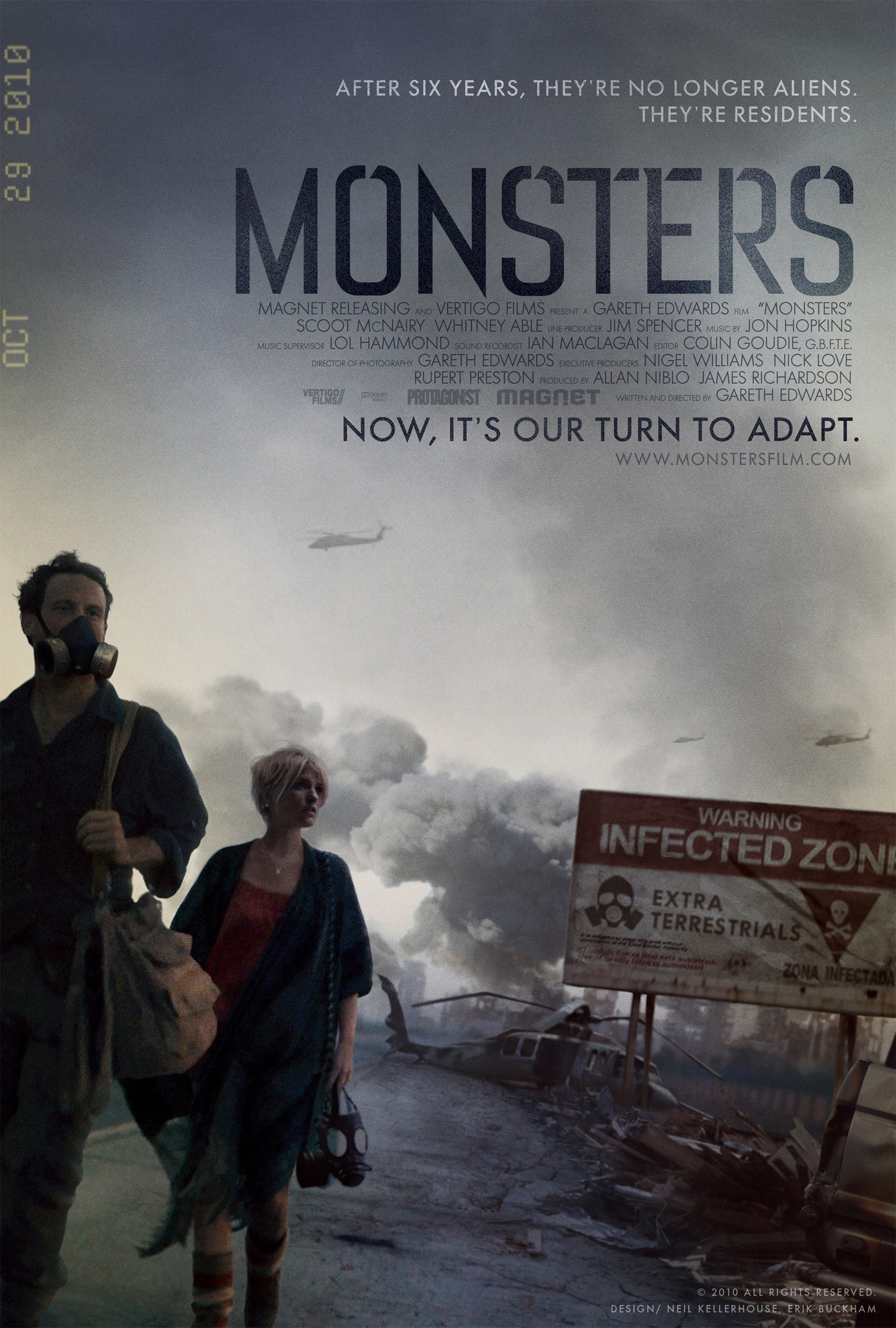
Monsters


The independently-made sci-fi films that have been popping up over the last two years have more than proved that smaller films in this genre can compete, and in some cases completely outclass, the studio-funded big guns. Monsters is one such example, beautifully crafted from a tiny budget (reported to be anything from $15,000 to $500,000), with a miniscule cast (two professional actors) and a crew of four, including creator, director and cinematographer Gareth Edwards (making his feature film debut).

A road movie, a love story and a travelogue, Monsters is not much like a sci-fi film at all. Taking a unique spin on alien invasion, the film’s premise has similarities to District 9, with alien life forms taking up residence on Earth, in an area that is economically deprived. But here is where the comparison ends; Monsters treads a very different path, creating an engaging and poetically humanistic film.

The story takes place in the ‘Infected Zone’ of northern Mexico, as an unlikely pair of travellers try to make their way northwards – and homewards – to the United States: photojournalist Andrew Kaulder (Scoot McNairy) and his boss’s daughter, Sam (Whitney Able), who he has reluctantly agreed to escort. The film’s success owes a huge amount to the chemistry between its two leads, a couple in real life. While this is an obvious advantage, the quality of their performances shouldn’t be underestimated.

Monsters is a good-looking film, with Edwards creating a lovely visual lyricism from Central American landscapes. As the person behind the special effects he has also created magic in post-production, providing the all-important extra-terrestrial action.

With clever political undertones, an affecting love story and gigantic squid-like aliens, Monsters may just be the best sci-fi film of 2010.

4/5

First published in The Brag 30/11/2010

Image 1

Sunday, December 12, 2010

Due Date


In Due Date successful architect Peter Highman (Robert Downey Jr) is stuck making a cross-country road trip with wannabe-actor Ethan Tremblay (Zach Galifianakis), after they are both thrown off a plane flight by an over-zealous Air Marshall. On a strict deadline, and with his wallet and passport still on the plane, Peter opts to hop a lift with Ethan, in order to get back to LA in time for the birth of his first child, with wife Sarah (Michelle Monaghan). Along the way Peter learns about fatherhood and friendship from his eccentric travel buddy, through a series of incidents that includes masturbating dogs, violence against children, and various car wrecks.

With its gross-out humour and overly manipulated set-ups, Due Date is more cringe-worthy than humorous. The film feels like it has been pieced together from the leftover scraps of funnier, more entertaining films. The writers appear to have a checklist of comedy props – annoying child, ugly pugdog, angry war veteran, scary Mexican immigration officials – that they were obliged to mould into a coherent storyline. Any attempt by the filmmakers to say anything even vaguely true about fatherhood or friendship appears tacked on, as if the only way they can get away with the series of idiotic jokes is to inject in the odd emotional revelation.

What is most disappointing is that Due Date hasn’t been made by talentless hacks, and doesn’t have a second-rate cast. Downey Jr. and Galifianakis could and should have made a more appealing pair for a buddy film, but director Todd Phillips (The Hangover) hasn’t been able to balance the pairing at all, and both come off as highly unlikeable characters. Obviously playing on The Hangover riff that did so well last time, Phillips is too reliant on Galifianakis as a visual gag.

Saying all this, the film has already made back its budget of $65 million at the US box office, with a pretty hefty bit of change on top of that. So there is definitely an audience for this film, and (knowing the laws of Hollywood) an even more depressing sequel is probably already in the pipeline.

1.5/5

First published in The Brag 30/11/2010

Image 1

Tuesday, November 23, 2010

Josh Fox Interview

An interesting episode in the life of Josh Fox

Josh Fox, US documentary-maker and current mouthpiece of the anti-natural gas drilling movement, has been on what he calls “an exhausting and comprehensive” tour with his film, GasLand. Launching screenings with local grassroot organisations across America and then travelling to Australia for Q&As in Brisbane, Sydney and Melbourne, Fox’s role is one firmly stuck between filmmaker and activist. Tired but still obviously spurred on by the environmental damage he’s seen and the threat to his own home, Fox is determined to continue spreading the message of the film.

GasLand is part exposé, part personal travelogue. The project began when Fox received a letter from a gas company offering $100,000 to lease part of his family’s upstate New York estate for exploration. Instead of signing on the bottom line like many of his neighbours Fox- a theatre director and part-time banjo player- decided to investigate the natural gas industry. “I was in the middle of a raging debate in my area between people who wanted this development and people who didn’t, and I just wanted to find out who was right.”

At the outset of his journey Fox was oblivious to the extend of the damage that hydraulic fracturing (a process for drilling for gas) was causing across America. It was a trip to the town of Dimock, Pennsylvania (shown in the film) that spurred Fox on to action. Interviews with residents there revealed flammable drinking water polluted by chemicals involved in the drilling process and massive health problems caused by toxic emissions. Fox felt terrified.

“I came home [after visiting Dimock] and I couldn’t sleep for a month, I still can’t sleep sometimes when I think about it, because I feel the walls closing in and I feel like I might have to leave.” Indeed, Fox's greatest fear is that he may not ultimately be able to halt the drilling process. “Here I am down in the valley, a lot of the property up on the hill, to the north side is leased. My immediate neighbours to my left and to my right are not leased, but what if they sell their house and the next person leases? … Even if they just drill the properties up on the hill, all those toxic emissions, and I know what they are, are going to waft down and collect in the valley.”

Watching GasLand it is hard not to feel outraged and angry. The film shows how gas companies in the US have been allowed to by-pass environmental laws. But despite all of his alarming and depressing findings you never see Fox angry in the film, which is surprising. “I think I am in shock myself a little bit about that, I think I am really deeply angry, I don’t think that is the way to express it though.” Fox pauses before continuing “Here is the thing, I think you have to leave space for your audience to make up their own mind… GasLand is a series of questions, put forward from a reasonable perspective, and it is in the audience’s hands to figure out what they need to do or what they think. You’ve got to come charging in at the end of the movie, not me, I’m already charging.”

Converting audience outrage into action isn’t easily done, but this filmmakers isn’t shy about pointing the way. “I think people have to be in the streets protesting about this, in the major cities. I think you have to have, at the locations, civil disobedience. The popular opinion has to turn and say ‘no, we are citizens of this country and we really want to examine this before industry comes in and decides to buys out our continent and our government’. At the beginning of the process I was really interested in preserving my land and my house, now the most important objective to me is to move the Earth towards renewable energy. Its about all of us investing in the great change that is to come, which is to get off fossil fuels. And natural gas is dirty just like fossil fuels.”

Perhaps unsurprisingly, Fox has attracted a smear campaign determined to discredit both him and the film. “A lot of people have said ‘hey you are getting to them, they’re attacking you’. But it sucks. Here is the thing that bothers me about it, what they [gas companies] are saying is so obviously a lie, they are lying through their teeth. I would like to see journalists challenge them on their lies instead of me having to deal with it. When they come out and say ‘We’re not exempt from the Safe Drinking Act’ the rudimentary level journalist could just look it up and see they are lying. And if they try and put that question to me, the journalists should chime in and say ‘sorry we know you are lying’. That’s is the part of it that pisses me off, the fact that they are able to hit one spin cycle in the media and disrupt the conversation with something that is such an obvious untruth.”

Becoming the mouthpiece of a cause certainly doesn’t come without its problems, but Fox with his wry sense of humour, seems to be coping. “The film has put the human face on this issue, on gas drilling…For me it is a really interesting rollercoaster. Isn’t this an interesting episode in the life of Josh Fox, I wonder what will happen next?”

First published in The Brag 15/11/10

Images 1,2,3

Tuesday, November 16, 2010

The American

For his sophomore film, Dutch director Anton Corbijn (Control) gives us a slow-paced Euro-thriller, adapted from Martin Booth's novel A Very Private Gentleman. The central character has been changed from British to American, with George Clooney cast against type. Filmed largely in the stunning Abruzzo region of Italy The American is visually impressive, but light on substance.

Jack (Clooney) is a hitman/gunsmith who begins the film in Sweden, where he commits as act of violence that will haunt him throughout the rest of the film. Escaping to Italy he hides out in a small countryside town and takes on a new assignment for a mysterious client (Thekla Teuten, In Bruges). The town's elderly priest (Paolo Bonacelli) quickly sizes Jack up as someone whose soul is in torment, and tries to befriend him, but Jack is a little more interested in getting to know Clara (Violente Placido), a beautiful and vivacious prostitute. However the quaint old town is full of dark, cobbled, maze-like alleyways and Jack, who is unable to escape his past, is constantly on guard for enemies lurking in the shadows.

Clooney, rightly or wrongly, is associated with characters that are charismatic and amiable. Jack, on the other hand, is solemn and cold; too hard a character to care about, not because of his immoral choices but because we find out so little about him during the course of the film.

The American suffers from being too earnest and relying on a heavy amount of visual symbolism, struggling to find a suitable way to express the film's message without banging the audience over the head with it. Corbijn's lack of subtlety as a filmmaker means that when he does make smart choices he is unable to do so without pointing it out to his audience, spoiling the magic somewhat. Corbijn coming from the world of photography and music videos certainly knows how to make a visually engaging film, but he hasn't quite learned how to tell a good story yet.

2.5/5

First published in The Brag 8/11/2010

Images 1,2