Thursday, September 9, 2010

Tomorrow When the War Began


John Marsden’s Tomorrow series has been a staple of high school English in Australia for years now. Yet it has taken quite a long time for such a popular (and obvious money spinner) to be adapted to the screen; making his directorial debut with the first book in the series Stuart Beattie, a successful Australian screenwriter, of this young adult adventure story. Beattie, who also wrote Pirates of the Caribbean: The Curse of the Black Pearl, Collateral and Australia, managed to convince Marsden to let him make a film of his beloved book, a proposal the author has been turning down for years. With a cast of young fresh-faced, but largely inexperienced film actors, and an untested director – has Tomorrow When the War Began successfully transferred from page to screen?

For the large part, yes – the film succeeds thanks to the enthusiasm and youthful optimism of its cast and crew. TWTWB is by no means a masterpiece, but it is hugely likeable – this is coming from someone who was not relishing the prospect, having disliked the book. The cast of young Australian and British actors and the simple storytelling combine to make a good action film, a genre not common to Australian cinema at the moment.

TWTWB sees seven high school friends, who live in a small country town, take a trip to a remote camping spot call ‘Hell’ during school holidays, only to find when they return that the country has been invaded by a foreign force that wants their share of Australia’s natural resources. Forced into action, the group start their transformation into resistance fighters.

Leading the friends is 17 year old farm girl Ellie (Neighbours alumni Caitlin Stasey), who along with fun best friend Corrie (Rachel Hurd-Wood, Peter Pan) has handpicked a group of friends to go away with. Included in the mix is Corrie’s sporty boyfriend Kevin (ex- Home and Away-er Lincoln Lewis), Ellie’s love interest Lee (Chris Pang, Home Song Stories), the school’s beauty queen Fiona (Phoebe Tonkin), Ellie’s bad boy neighbour Homer (Deniz Akdeniz) and the religious Robyn (Ashleigh Cummings). This core cast do a great job of being realistic teenagers – a rare thing for young adult films. There are a few weak links, but you can only hope with experience they’ll rise to the standards of their cast-mates (or get killed off as the series progresses – I never got past the first book). Particularly strong is the youngest cast member, Cummings, who tackles the moral compass character of Robyn and Stasey whose portrayal of the determined Ellie is a strong anchor for the film. Andrew Ryan (The Jesters) brings some comedic relief to the film with his stoner performance of Chris, who joins the group during the film.

While there is the obvious cringing reference to the first settlers’ invasion of Australia and the odd scripting slip-up, Beattie’s debut is for the most part impressive. His experience on big budget projects has definitely brought with it the skills to finesse action sequences. Not outrageous or ostentatious the films fight sequences and gun-play is handled in a way that suits the setting of country town war zone. It is rare to see an Australian made film with such a large budget (a reported $25 million) and it is nice to see it hasn’t been wasted.

Images 1,2

First published on Onya

Sunday, September 5, 2010

Father of My Children


Young French filmmaker Mia Hansen-Løve won the Cannes Special Jury Prize in 2009 for her sophomore film (which she wrote and directed), Father of My Children/ Le père de mes enfants. The film, inspired partially by the life of French film producer Humbert Balsan, follows the fictional character of Grégoire Canvel (Louis-Do de Lencquesaing) who runs a small company producing art-house films, and has a loving family with supportive Italian wife Sylvia (Chiara Caselli). Behind the happy façade everything is not quite as rosy as it seems and increasing financial debt pushes Canvel to drastic action.

This French film offers a fascinating insight into the mechanics of independent filmmaking, the nitty-gritty of financing and location hunting. The role of producer is one that is frequently vilified as someone concerned with money not art and here in this film, Hansen-Løve shows the dedication and passion of small production companies, like the film’s fictional Moon Films, that enable less commercially appealing films to be made. Canvel may not be a very good businessman, but his commitment to filmmaking is unquestionable. Louis-Do de Lencquesaing imbues Canvel with charisma, giving the character instantly likeable, which makes the slow crushing of his spirit by his financial woes all the more affecting.

Along with the family of colleagues that Canvel has built up at his company, the film also shows the idyllic home life that Canvel shares with his wife and children- the increasingly independent eldest daughter Clémence (Alice de Lencquesaing), and two exuberant younger daughters Valentine (Alice Gautier) and Billie (Manelle Driss). These three young actresses give the film its heart. Gautier and Driss are fantastic as these two switched on, adorable youngsters. Alice de Lencquesaing, who was impressive in her small role in 2008’s Summer Hours, is compelling to watch on screen with her character’s getting its own rewarding emancipation story arc.


Father of My Children tackles a heavy subject matter without being weighed down by the topic. Hansen-Løve could have easily made this film a cry-fest, but instead focuses on the strength of the family giving us a moving and charming film, instead of an emotionally fraught one. The subtle, tender sadness of the film trumps any of its small scripting problems and certainly marks out not only the film’s young cast members but also the director as ones to watch.

Images
1,2

First published on Trespass

Tuesday, August 31, 2010

Interview with Taika Waititi and James Rolleston


After his Oscar-nominated short Two Cars, One Night (2005), which swept awards on the festival circuit, New Zealand director Taika Waititi confounded critics and audiences with his debut feature, the super-oddball and darkly comic Eagle vs Shark (2007), which starred Jemaine clement (pre-Conchords fame. With His sophomore feature Waititi hits the mainstream, with a charming, big-hearted comedy that won the audience prize at this year's Sydney Film Festival, and has become the highest grossing New Zealand film of all time.

Filmed in New Zealand’s North Island in the small community of Waihau Bay where Waititi grew up, Boy is set 1984, at the height of Michael Jackson's Thriller-fever. As the film sees two young brothers- Boy (James Rolleston) and Rocky (Te Aho Eketone-Whitu) adjusting to their father Alamein's (Waititi) return home after a seven-year stretch in jail. For 11-year-old Boy this involves creating a vivid fantasy in which his father is a superstar of a war hero; the reality is a lot more disappointing.

Waititi, who describes Boy as inspired by both “true and imagined memories”, spent a few years writing the script; however after making a number of successful short films, decided he didn’t want to make Boy his debut feature. “I just felt like I wasn’t really ready to make my first film, in my home town”, he explains. Instead Waititi chose to focus the smaller-scale Eagle vs Shark. “I thought just make something really small and that I could sort of learn how to make a feature film on. Learn from any mistakes I would make on that and apply that knowledge to Boy.”

As with his earlier films, Waititi infuses Boy with his own unique blend of comedy and drama. Although he intentionally plays with tone in his film, he is concerned by how this mixed genre filmmaking is sold to audiences. Eagle vs Shark was really hard to market...Like in the States it was marketed as an all-out comedy and people went along and went- ‘ah it’s not that funny’- there are actually some really depressing parts to it. People go along expecting one thing and then it takes them a while to adjust, to figure out why it’s not as funny as the poster.”

One of Waititi's main challenges with Boy was finding the right actor to carry-off Alamaein's fundamentally immature character in a way that was also sympathetic. “I like that this character, who is obviously a dickhead, has got some really loveable parts to him as well. He actually tries, but it is just a really twisted way that he attempts to connect with his kids.”

After almost a year of struggles, Waititi decided to cast himself in the role. “I had recalled people probably 6-7 times and just wasn’t really getting something different, something I hadn’t seen before. I just felt it was kind of typical of what we are known for in New Zealand, that kind of acting, or that kind of portrayal of Maori men. I wanted the character to be obviously clumsy and kind of uncomfortable in his body. It just felt like most of the people who were auditioning they just tried to be tough.”

Rolleston was originally cast as an extra, rather than the lead. “I was in class and a lady came in and asked us if we wanted to do some auditioning for a feature film, me and my mates put up our hands. I got to the audition and I met Taika and I had to do a skit and I got cast as an extra. When I went to go have a wardrobe fitting I was just walking around introducing myself, saying hello to people and everybody was blown away and then three days before shooting I was cast [as Boy].”

Given the pressures on Waititi in the lead up to filming and given Rolleston’s late casting, there wasn’t much time to build up rapport between the film’s family unit; however Waititi suggests this inadvertently added to his character development. “I was so busy I couldn’t hang out with them [the child actors], so I actually felt like a bad dad right from the start because I wasn’t paying them that much attention.”


With Boy's success in his home country, one wonders how Rolleston has navigated the media attention. “I’m not really a fan of any of this [publicity]" he admits- "I get quite shy. I get shy as when people call out my name in the street, because everybody looks.” This hasn’t dented Rolleston’s interest in films though “I’m hoping to do more acting,” but he also adds “ I’d like to do other things as well, like marine biology, or have my own hunting show, or both.”

Meanwhile, Waititi’s next role is in Martin Campbell's comic-book adaptation Green Lantern (out 2011). “The casting agents had seen [Boy] at Sundance and asked if I would read for a part in the film. It seems quite preposterous to me that I even got into it but it was really enjoyable, seeing the whole Hollywood thing, just a new experience.”

With Waititi spending about half his time in the States at the moment, what is happening with his own filmmaking? “I am writing scripts some are set back home and some are set there [US], it is just a matter of whatever gets finished first and whatever gets funded first. It hasn’t been too hard getting interest in the States. Things are looking pretty good so far.”


Images 1,2,3,4

First published in The Brag 23/08/10

The Killer Inside Me


Anyone with even the vaguest interest in films is aware of the hoopla surrounding British director Michael Winterbottom’s (24 Hour Party People) first American film and the levels of violence it depicts. Unfortunately the discussions around The Killer Inside Me means that as a viewer you can never watch it without some prior knowledge and the influence of the strong opinions surrounding its content (consider not reading on if you have managed to avoid hearing anything thus far).

Based on a 1952 pulp novel by Jim Thompson (who also wrote The Grifters), the film follows Lou Ford (Casey Affleck), a sociopathic, small-town deputy sheriff, viewing the action from his perspective. With a loving girlfriend, Amy (Kate Hudson) and a seemingly contented life, Ford’s hidden nature comes to the fore when he is asked to run Joyce (Jessica Alba), a prostitute, out of town. When a blackmail scheme and the chance for revenge coincide, Lou’s psychotic behaviour is unleased on his unsuspecting friends and colleagues.

The thing that most film commentators have taken from The Killer Inside Me is its violence, which is graphically displayed and brutal to watch. There has been so much talk about this that you’re on tenterhooks watching the film. Ultimately anticipation robs the film of some of its power, dulling its confronting and shocking nature.

Winterbottom has defended his film against detractors, saying that violence on screen, especially realistically depicted, should disturb viewers. And he makes a good point, violence in films is rarely accompanied by any sense of its truly horrifying consequences. Perhaps more worrying to Winterbottom is the number of people who accuse the film of being misogynistic.

With a highly stylized noir aesthetic and impressive performances from the whole cast, including an excellent turn from Affleck, this is a good film, but really nothing more. It isn’t the profound look at human nature, or the unique take on the genre you might have expected from a director of Winterbottom’s calibre; but then again it isn’t the gratuitously violence, exploitation film that has been suggested either.

3/5


Images 1,2

First published in The Brag 23/08/10

Saturday, August 28, 2010

Four Lions


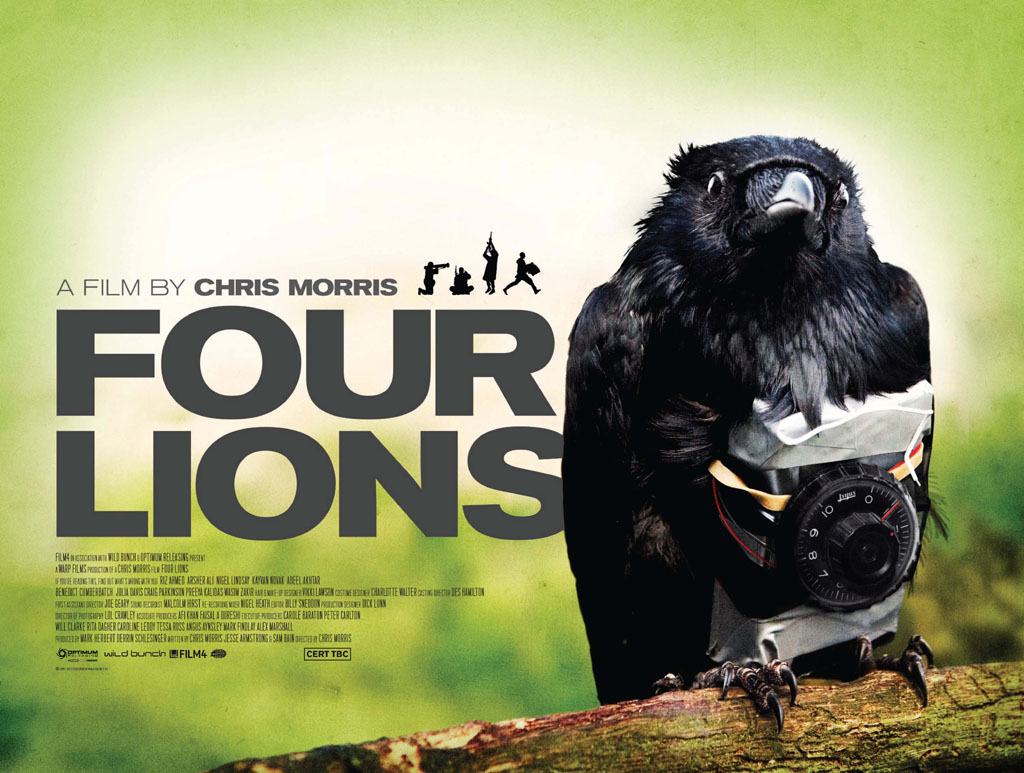
Chris Morris’ tv shows in Britain have caused outrage, controversy and hours of amusement. Whilst his ‘edgy’ humour isn’t to everyone’s taste, his scathing appraisals of the media, hipsters and celebrities has borne fruit in cult hits like Brass Eye and Nathan Barley. Now turning his hand to filmmaking, Morris has chosen a topic which seems completely inappropriate for comedy- terrorism. Four Lions follows the fortunes of a small group of British jihadists as they attempt to come up with a way to strike a blow against a country they feel alienated from. In the same way that This is Spinal Tap looked at heavy metal music, and In the Loop looked at transatlantic politics, Four Lions is a farce looking at the modern idea of terrorism.

Morris spent three years researching the topic speaking to terrorism experts, police, secret services, imans and members of the British Muslim community. What he found was there were plenty of comedy elements that already existed in the situation- like a terrorist cell that accidently overloaded their boat with explosives, so it sunk before reaching its US warship target or a terrorist mastermind who spend hours looking for a costume that wouldn’t make him look fat in his martyrdom video. A jihadist cell- like any other grouping of people- is full of misunderstandings, petty rivalries and bravado. Morris sums it up pretty succinctly-“Terrorism is about ideology, but it’s also about berks.”

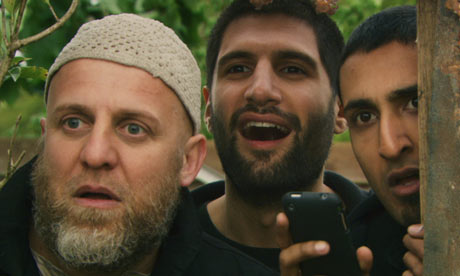
Four Lions’ jihadist cell consists of: Omar (Riz Ahmed, Centurion), the unofficial leader of the group, who has an uncle in Pakistan with links to training camps; Waj (Kayvan Novak, The Fonejacker) who doesn’t have much going on upstairs, relying on Omar to do all his thinking; Barry (Nigel Lindsay), a white Islamic convert who is overly public about his views and really wants to be leading the cell; Faisal (Adeel Akhtar, Traitor) a quiet, sad man who worries about blowing himself up because then who’ll look after his sick dad. This group struggles to come up with a plan of attack they can all agree upon, with the ever antagonist Barry unilaterally recruits another member, Hassan (Arsher Ali) a university student/wannabe political rapper.


There are times when the humour in Four Lion slips into silliness, but for the majority of the film it is sharp thanks to the scriptwriting of Sam Bain and Jesse Armstrong (Peep Show). At times it almost feels like you are being deceived by the comedy and wonder if you should be laughing at what you are seeing. This is the clever thing about this film- as it progresses you actually feel quite sorry for the men at the centre of the film. They are hopelessly inept and are confused about their grievances. Omar’s family scenes are particularly depressing- he explains jihadism to his young son using Disney’s Lion King as an analogy. Morris doesn’t allow his characters to escape responsibility just because the film is framed as a comedy, nor has he made his characters simply idiotic and sat back and poked fun at them, his purpose is to show how the whole situations has become a farce.

Four Lions is a film you expect to be funny given the comedic talent attached, but surprisingly it is also strangely moving as well.

Images 1,2

First published on Trespass

Monday, August 23, 2010

Interview- Ruba Nadda

Canadian-Syrian filmmaker Ruba Nadda has been receiving rave reviews for her film Cairo Time. An old fashioned romance, the film shows off the talents of Patricia Clarkson and Alexander Siddig and the beauty of Egypt’s capital city. Ruba Nadda spoke to The Brag about working with her dream cast and the trials of filming with a censorship lady in tow.

In Cairo Time, Juliette (Clarkson) arrives in Cairo to find her husband has been delayed by work and has sent an ex-colleague Tareq (Siddig), a local, to meet her. As the film progresses a delicate romance plays out as Juliette discovers the delights of the city. This 'West meets Middle East' story has two unconventional romantic leads, a woman in her 50s and an Arab man. “I have always been obsessed as a filmmaker with trying to break down the misconceptions about the Middle East and Arab men in general”. But it was the age of Nadda’s female protagonist that caused the most worry-“I remember our financiers for the film trying to convince me to change the character and make her in her 20s or her 30s. I was really firm about having her being in her late 40s. In the movie she’s 50. For me it was really important to keep her at that age-I knew had it been a woman in her 20s, it wouldn’t have carried the same kind of weight.”

Cairo Time’s success is reliant on the central performers’ chemistry, and Nadda had an ideal cast in mind- “I wanted Alexander badly. I’d written the role for him, I’d been a huge fan of his over the years. And then I wanted Patricia. I just saw them together, I felt that they fit.” How did Nadda know these two actors who had never worked together would have the right energy? “the thing about romances is that it is all about the chemistry- either the characters have the chemistry or they don’t, and when they don’t they [romances] can be brutal. I winged it, I prayed that by casting these two people, and not having them audition in a room together, I prayed that they would have that chemistry. I remember filming the first shot and they were unbelievable, and so it worked. Making movies it’s kind of fate, it’s kind of like chance, sometimes you have to just go with it.”


Nadda can’t praise her stars enough- “the thing about Alexander and Patricia is that they are so experienced , they’re so amazing, so talented, when I had talked to them about their characters and the story, they really got it.... The thing about Patricia is that she is a powerhouse of an actress and so it was a lot of fun collaborating with her, she’s a very smart woman.”

Of course the other great character of the film is Cairo itself, a place that had captured Nadda’s imagination a long time ago “I always had Cario in mind. My parents are from Syria, they’re Arab. They took us [Nadda and her sister] on a visit when I was 16, to Cairo and it enchanted me so much that I just became obsessed with the city, and I basically pocketed the image of this amazing place, this atmosphere in my brain until many years later I thought I have to set a story here.”

Nadda’s script had specific famous locations written in, some of which had never been open to film crews before- the Pyramids and El Fishawis coffee shop. Nadda had to use her Syrian nationality to get access to these areas -“I would say ‘look I’m an Arab filmmaker, you have to give me permission, you can’t say no to me’”.

Nadda was similarly determined when it came to protecting her project against external pressures. “I was really committed to not altering the script because of the Islamic censorship. I was like ‘you’re not putting money into this movie, you’re not going to tell me how to shoot it’. My crew and I felt very strongly that if we got Cairo, we were not going to get pushed around. The script I wrote, I basically shot in the end. I am actually quite proud of that, because it was a real battle with the censorship woman, who was hired by the government and who literally signing every reel before they were being shipped back.” Nadda and her team had to come up with ways to circumnavigate their unwanted government tag-along- “for certain scenes I had to get rid of her because she wouldn’t have allowed us to film. So we had all these little ploys and plans for removing her when we needed to”.

Cairo Time with its lovely balance of visual wonder and character charm, has earned its director some long awaiting kudos at home. “I’ve been an outsider to Canadian film for many years, and all of a sudden with Cairo Time, it’s like I’ve finally been accepted into the kind of filmmaking clique here, it feels nice.”

Images 1,2,3

An abridged version of this interview was published in The Brag 16/08/10

Saturday, August 21, 2010

Everlasting Moments


Everlasting Moments/Maria Larssons eviga ögonblick comes from one of the great European auteurs, Swedish director Jan Troell, now in his late 70s he is known for films like Emigrants (1971), Bang! (1977) and Il Capitano (1991). Celebrated around the world, Troell’s films often look at the lives of Sweden’s working class, which is again the terrain he covers in this his latest film. Based on a real–life woman, Maria Larsson (Maria Heiskanen), Troell takes his audience into the landscape of early Twentieth Century Sweden weaving a beautiful narrative around his central character and her passion for photography.

Troell became aware of Maria’s story through his wife, Agneta Ulfsäter-Troell’s research into her family history (Agneta is a distant relative of Maria). Over a number of years Agneta interviewed Maja Öman (Maria’s eldest daughter) and found out about Maria’s photography; Maria had won a camera in a lottery as a young woman and despite constant financial troubles had kept hold of it all her life. Troell, realising the social significance of Maria’s story and himself a devotee of still photography, set about turning his wife’s research, along with Öman’s memoirs, into a script, which he co-wrote with Niklas Rådström.

Everlasting Moments examines the adult life of Maria, a working-class mother of seven, married to the often brutish drunkard Sigfrid (Mikael Persbrandt). The film looks at the family’s struggle to keep their heads above water, the changes in Northern Europe during the beginning of last century and Maria personal engagement with photography. This is a film that slowly entices you in, with its fantastically realised sense of place and time and excellent performances.

Although Maria wasn’t a leader in the field of photography or a renowned photographer, the film’s exploration of the burgeoning art form is absolutely absorbing. Under the kind tutelage of the delightful photographer Pedersen (Jesper Christensen), Maria’s nature gift for photography develops and she discovers this very powerful method for self-expression.


Troell wrote the script with Finnish actress Maria Heiskanen in mind for the central role, and watching the film you can see she was the perfect choice. Equal measures vulnerable and stead-fast, Maria is a fascinating character. The film balances Maria’s responsibilities and choices with her desires; although there is an inevitable sense of melancholy to the character, there is also a joy and determination making Maria more than just a put-upon wife and mother.


Images 1,2

First published on Trespass